
Dri-Eaz Water Damage Restoration in Elmhurst: A Homeowner’s Guide
Dri-Eaz is the most trusted name in professional drying equipment, but the brand on the dehumidifier matters less than whether the technician knows how to read its data. A LGR dehumidifier sitting in a wet Elmhurst basement without a psychrometric baseline set on day one is roughly as useful as a shop vac. This guide explains what Dri-Eaz equipment actually does, what the numbers on its readout mean, and how to use that knowledge to hold any restoration crew accountable. If you’d rather skip the technical details and get a free assessment, call (363) 999-0829.
What “LGR” Actually Means and Why It Matters in Elmhurst Basements
LGR stands for low-grain refrigerant. It’s not marketing jargon. It describes how the dehumidifier’s cooling coil operates, and it directly affects how much water the machine can pull from the air in a given hour. Conventional dehumidifiers, the kind you might buy at a hardware store, use a standard refrigerant system that struggles once relative humidity drops below about 50 percent. LGR units keep pulling moisture efficiently down to the low 30s and 40s in relative humidity. That matters in Elmhurst because Queens basements sit close to the water table and hold humidity differently than above-grade rooms. The ambient moisture load in a semi-enclosed basement off Broadway or near the LIE means a standard dehumidifier will plateau early, leaving the structure damp enough for mold to take hold.
We’ve taken moisture readings in Elmhurst homes where the homeowner had been running two big-box dehumidifiers for a week and the drywall still read 25 percent moisture content. Visible surfaces felt dry to the touch. Behind the baseboards, the framing was still wet. An LGR unit like the Dri-Eaz LGR 3500i or the Evolution LGR pulls water at a rate that conventional machines simply can’t match when the air gets dry but the structure hasn’t caught up. That low-grain capability is the difference between a four-day dry-out and a two-week headache that ends with tear-out.
Reading a Dri-Eaz Moisture Log: GPP, RH, and Temperature
A Dri-Eaz dehumidifier with a data logger records three key numbers every day: grains per pound (GPP), relative humidity (RH), and temperature. These three figures tell you whether the drying process is actually moving in the right direction. GPP is the most important number most homeowners never see. It measures the actual weight of water vapor in the air. RH is a percentage, but it’s relative to temperature, which means it can mislead you. GPP doesn’t lie. A drying structure should show GPP dropping steadily day over day. Relative humidity should fall into the 30 to 45 percent range and hold there. Temperature matters because warmer air holds more moisture, and professional drying runs warmer on purpose to accelerate evaporation.
What should worry you is stalled numbers. If GPP holds flat for three consecutive daily readings, water is still entering the air somewhere and evaporation has plateaued. That usually means the water source wasn’t fully stopped, or there’s a hidden pocket of saturated material the air isn’t reaching. We’ve walked into Elmhurst homes where another company’s dehumidifier had been running for five days and the GPP reading was identical to day one. The machine was working. The drying plan wasn’t. Moisture mapping on day one, with a baseline set in an unaffected area of the home, is what lets a technician know whether the numbers are actually improving or just running in place.
Matching the Dehumidifier to the Job: Dri-Eaz Models and Square Footage
Not every Dri-Eaz unit fits every water loss. Deploying the wrong size equipment is a common way restoration companies cut corners, and most homeowners have no way to check it. The Dri-Eaz LGR 3500i is rated to pull up to 80 pints per day at AHAM conditions and handles small to midsize losses: a burst supply line under a kitchen sink, a bathroom overflow, a single-room leak with maybe 300 to 500 square feet of affected flooring and drywall. The Dri-Eaz Evolution LGR is bigger, rated at up to 145 pints per day, and built for larger events: a failed water heater that flooded a full finished basement, a roof leak that saturated multiple rooms, or anything where affected square footage pushes past 800 square feet. Pairing an undersized dehumidifier with a large loss is like running a window air conditioner in a warehouse. It’ll run constantly, log data, and never get the job done.
Elmhurst homes present a specific challenge here. Many of the attached brick row houses and older frame homes have plaster over masonry, and plaster dries differently than modern drywall. It holds water longer and releases it more slowly. That means the drying plan has to account for days of additional evaporation, and undersized equipment will stall early when the surface readings look fine but the plaster core is still saturated. Ask the restoration company what model they plan to deploy and why it matches the square footage and materials of your specific loss. If the answer sounds vague, get another opinion.
Why Equipment Alone Doesn’t Equal a Dry Structure
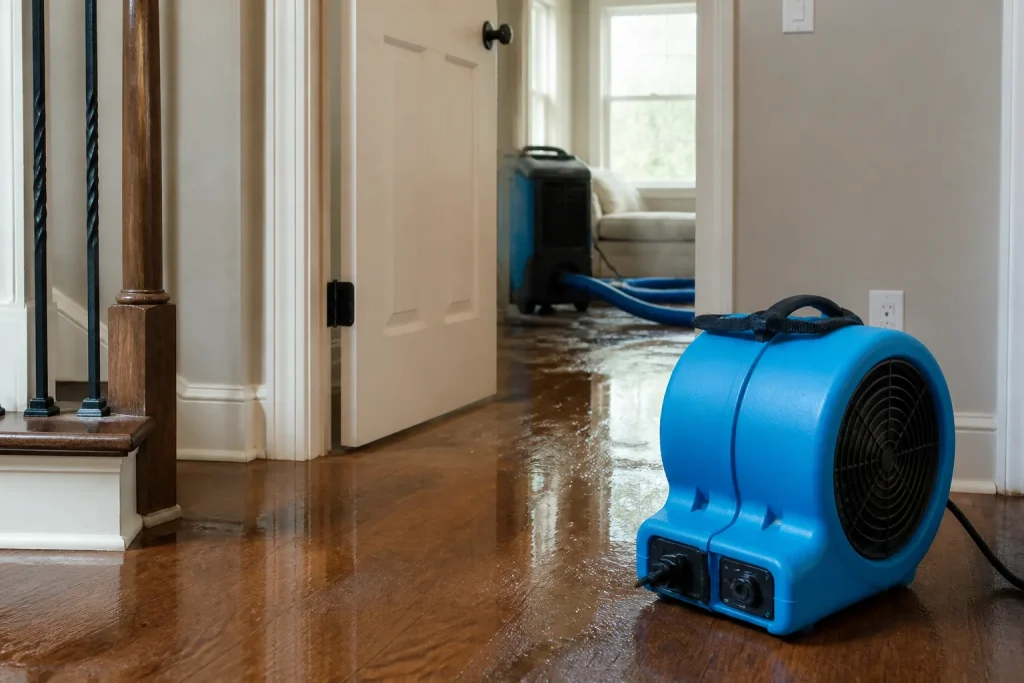
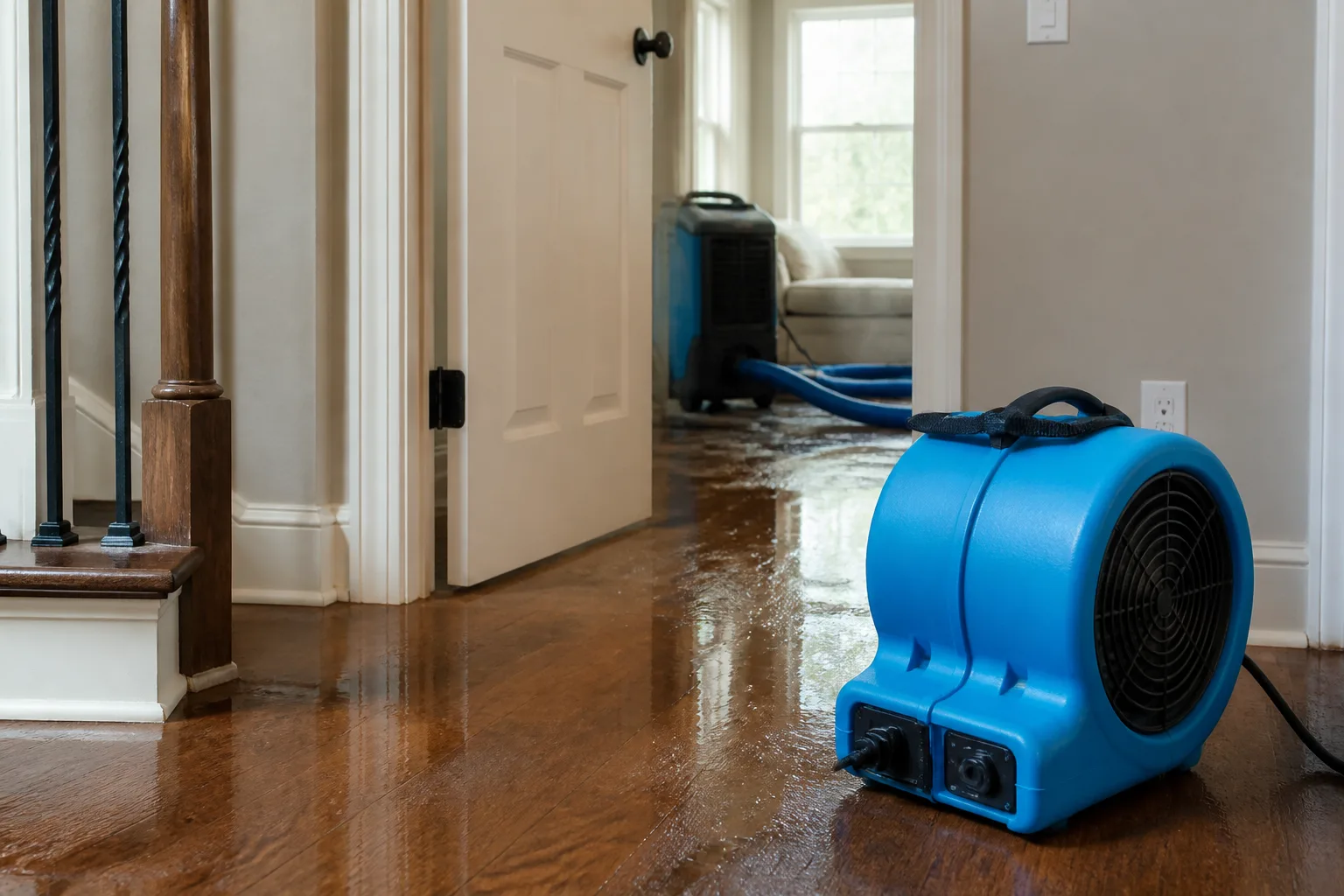
A powerful dehumidifier is just one tool in a drying system. Without negative air pressure and directional airflow, even the best Dri-Eaz unit can only dry the air directly around it. The water trapped inside wall cavities, under cabinets, and beneath flooring needs moving air to carry moisture from wet materials into the room, where the dehumidifier can capture it. Negative air pressure, created by exhausting air to the exterior with a fan, pulls replacement air through the wet cavities and toward the equipment. Directional airflow means technicians place air movers, like our XPOWER and B-Air units, so that the air path covers every affected surface at the right angle and distance. A dehumidifier sitting in the middle of a wet room with no air movement is doing one-fifth of the job.
Daily monitoring is the other half. IICRC standards call for daily moisture readings and equipment adjustments until the dry standard is met. That standard is specific: affected materials must return to within a few points of their dry baseline, verified with a moisture meter, not a guess. We put eyes and meters on every Elmhurst job every single day until the numbers prove the structure is dry. The equipment log goes to the homeowner and the carrier. That documentation is what protects you if a dispute comes up later about whether drying was completed properly.
Questions to Ask Any Restoration Company Before You Sign
Before you authorize work, you have a right to know exactly how the drying will be measured and documented. These questions filter out companies running equipment without a plan:
- What’s my psychrometric baseline in an unaffected area, and what are today’s GPP and RH readings? If they can’t produce baseline numbers before setting equipment, walk away. You can’t measure progress without a starting point.
- Which dehumidifier model are you deploying, and how did you size it to this loss? A legitimate answer references the affected square footage, materials, and the unit’s AHAM-rated capacity. A vague answer means the warehouse sent whatever was available.
- When was your moisture meter and dehumidifier last calibrated? Calibration schedules exist because sensors drift. Equipment that hasn’t been checked can report numbers that are several points off, which changes drying decisions. There’s no certification for “eyeballing it.”
- Will I get a written daily moisture log until the dry standard is met? If the answer is anything other than yes, you’re hiring someone who plans to pull equipment on a schedule instead of on the moisture data.
- Who handles my insurance paperwork? Photo documentation and direct adjuster coordination should be standard, not an upsell. A company that makes you play messenger between them and your carrier has already told you how the job will go.
We’ve watched Elmhurst homeowners sign authorizations without asking any of these questions, then call us afterward when the drying stalled and mold started. The equipment brand they’d been promised was Dri-Eaz. The problem wasn’t the equipment. It was the plan.
When to Call a Pro Instead of Fighting It Yourself
You can rent or buy a dehumidifier and a few air movers and make a run at it. For a small, contained spill with no drywall saturation, that’s a reasonable weekend project. But if water has been standing for more than a few hours, if it soaked into drywall or flooring, or if it came from a sewage source, the risk profile changes. The water inside wall cavities doesn’t care how many fans you point at the baseboard. Every day of incomplete drying moves you closer to mold remediation, which is a bigger, more expensive problem than water extraction ever was. That’s the moment to call a pro.
Elmhurst homeowners who want the job done right the first time should look for a company that uses professional-grade Dri-Eaz, Phoenix, and Injectidry equipment, logs daily moisture readings, and puts the dry standard in writing. That’s the standard Floodline Restoration Co. has worked to for over 42 years, led by Curt Bowman since 2010. If you’re not sure whether your situation needs pro equipment, call (363) 999-0829 and describe what happened. We’ll tell you honestly whether it’s a rental job or a restoration job.
Related services in Elmhurst: Water Damage Restoration in Elmhurst and Mold Remediation in Elmhurst.
The Bottom Line
Dri-Eaz equipment is excellent, but equipment doesn’t dry a structure. A plan does. The plan starts with a psychrometric baseline, includes correctly sized LGR dehumidifiers and directional airflow, and ends with a written moisture log that proves the home is dry. Ask for the data. A legitimate restoration company in Elmhurst will show it to you without hesitation. If you’re in Elmhurst and need help, Floodline Restoration Co. offers free estimates and direct insurance billing. Call (363) 999-0829.
Frequently Asked Questions
Professional water damage restoration using Dri-Eaz equipment in Elmhurst typically costs between $2,500 and $7,500 depending on affected square footage, materials, and how long the water sat. Small contained losses run lower. A full finished basement with saturated drywall and flooring runs higher. Your insurance policy often covers most of the cost, less your deductible. Call (363) 999-0829 for a free estimate specific to your situation, and ask about direct insurance billing.
A properly planned dry-out in an Elmhurst basement typically takes 3 to 5 days when the right LGR dehumidifier and air movers are paired with daily monitoring. Plaster walls and masonry can extend that timeline. The dry standard is met when moisture readings return to the unaffected baseline, not when a calendar says the job is done. A company pulling equipment on a fixed schedule rather than on the moisture data is leaving water behind.
You can rent LGR equipment from local supply houses, but without a moisture meter, a baseline, and a daily log, you’re guessing at whether the structure is actually dry. For a small isolated spill, a rental can work. For saturated drywall, flooring, or anything involving sewage, call a professional. The cost of incorrect drying shows up later as mold, and that bill is bigger than the restoration would have been. Floodline offers free assessments at (363) 999-0829.
In most cases, yes. Standard homeowner policies in New York cover sudden and accidental water damage, including the cost of professional drying equipment and labor. Coverage depends on your policy terms and how the water entered the home. Floodline Restoration Co. documents every job with photos and daily moisture logs and bills your carrier directly, so you don’t have to play messenger. Call (363) 999-0829 and we’ll walk through what your policy is likely to cover.
Written by Curt Bowman, Owner at Floodline Restoration Co., serving Elmhurst since 2010.
Need Damage Restoration Help?
Call Floodline Restoration Co. - licensed & insured, here with fast after-hours help in Elmhurst.
(363) 999-0829