
Quick Summary
Sudden plumbing failures and indoor water disasters require immediate homeowners insurance water damage cleanup to fulfill policyholder duties and prevent costly secondary structural decay. Floodline Restoration Co. bridges the gap between emergency extraction and claim navigation by delivering rapid moisture remediation alongside meticulous, carrier-ready line-item documentation. Readers will learn how to navigate covered versus excluded water losses and can contact Floodline Restoration Co. for 24/7 emergency water extraction, free visual inspections, and direct insurance billing.
Homeowners Insurance Water Damage Cleanup: Fast Claim Help
When a supply line snaps or a pipe bursts behind your wall, handling the immediate cleanup and the insurance claim at the same time can feel overwhelming. Water spreads through flooring and framing quickly, while insurance adjusters may take time to arrive on-site. Knowing how to manage the emergency response protects both your building and your financial recovery.
Homeowners insurance may cover cleanup and restoration when water damage results from a sudden, accidental covered cause, subject to the policy, deductible, exclusions, limits, and insurer determination. In 2024, 48.6% of Massachusetts homeowners insurance claims were for non-flood-related water losses. The reported average claim size for policies renewed during the reporting period was $14,957. As specialists at Floodline Restoration Co. observe, acting promptly helps prevent further damage and keeps your claim moving forward without unnecessary delays.[1] See also Elmhurst Water Damage Restoration Costs | Call Now-10% Off | Same-Day Service | Free Estimate.
Does Homeowners Insurance Cover Water Damage Cleanup and Restoration?
Quick Answer: Homeowners insurance may cover cleanup and restoration when water damage results from a sudden, accidental covered cause, subject to the policy, deductible, exclusions, limits, and insurer determination. Standard homeowners insurance generally excludes flood damage from overflowing rivers, storm surge, and similar flooding, and separate flood insurance is typically required.[2]
Standard homeowners policies may cover sudden, unexpected water discharges from inside plumbing, heating, or air conditioning systems. Coverage may include water extraction, drying, sanitization, and the repairs needed to return your home to its pre-loss condition, depending on policy terms and insurer evaluation.[5]
Sudden and Accidental Losses vs. Excluded Maintenance Issues
Coverage generally depends on whether the failure was sudden or happened over an extended period. If a supply valve suddenly breaks, resulting damage is often evaluated as a covered loss. However, if water damage results from long-term seepage, gradual leaks, or poor maintenance, insurers generally exclude the claim.
| Loss Scenario | Standard Homeowners (HO-3) | NFIP Flood Policy | Maintenance / Wear and Tear |
|---|---|---|---|
| Burst Plumbing Supply Line | May be covered if caused by a sudden, accidental covered event | Generally excluded when the damage is flood-related or results from long-term seepage or poor maintenance | Generally excluded when the damage is flood-related or results from long-term seepage or poor maintenance |
| Overland Storm Surge / Surface Runoff | Generally excluded when the damage is flood-related or results from long-term seepage or poor maintenance | May be covered if caused by a sudden, accidental covered event | Generally excluded when the damage is flood-related or results from long-term seepage or poor maintenance |
| Slow, Unrepaired Pipe Seepage / Rot | Generally excluded when the damage is flood-related or results from long-term seepage or poor maintenance | Generally excluded when the damage is flood-related or results from long-term seepage or poor maintenance | Generally excluded when the damage is flood-related or results from long-term seepage or poor maintenance |
The Key Difference Between Water Damage and Flood Damage
Standard homeowners insurance generally excludes flood damage from overflowing rivers, storm surge, and similar flooding, and separate flood insurance is typically required. Coverage can provide up to $250,000 for a residential building and up to $100,000 for contents under the NFIP, subject to policy terms and eligibility.[4]
Why Waiting for an Insurance Adjuster Can Complicate Claims
Property owners sometimes leave standing water in place because they believe an adjuster must inspect the damage before any response begins. However, delaying mitigation can lead to increased structural damage and potential complications with your claim.
Taking Reasonable Steps: Understanding Policy Guidance
Property insurance policies include conditions outlining duties after a loss. Policyholders are expected to take reasonable steps to prevent further damage and follow the policy’s duties after loss. Shutting off the main water supply and arranging for initial water extraction to protect the property is consistent with these requirements.
How Stagnant Moisture Complicates Claims
According to Floodline Restoration Co., prompt drying can help limit additional damage and potential mold growth. Starting drying efforts promptly and preserving relevant damaged components where safe helps protect the structure and provides necessary physical evidence for the adjuster.
How to File a Water Damage Insurance Claim: Step-by-Step
Filing a homeowners insurance water damage cleanup claim requires organized documentation. Supported steps include:[3]
-
Step 1: Stop the Source and Secure the Area
Shut off the main water source where safe to do so. Preserve relevant evidence, such as the failed pipe or valve, where safe to do so for the adjuster’s review.
-
Step 2: Document the Damage and Notify the Insurer
Notify the insurer promptly. Photograph and video the damage thoroughly before and during initial cleanup, capturing water lines, damaged finishes, and affected personal property.
-
Step 3: Keep Records and Clarify Requirements
Keep receipts for reasonable emergency measures taken to protect the property. Ask your insurance representative what specific forms, itemized scopes, and records are required for your claim.
What Does Homeowners Insurance Water Damage Cleanup Cost?
Need homeowners insurance water damage cleanup?
We’re available now - call for a fast, free estimate.
Actual water cleanup and restoration costs vary widely depending on the volume of water, the category of water involved, and the extent of structural materials affected. When a claim is approved, reimbursement is subject to the policy terms, deductible, exclusions, and insurer determination.
Restoring Water-Damaged Drywall, Ceilings, and Wall Cavities
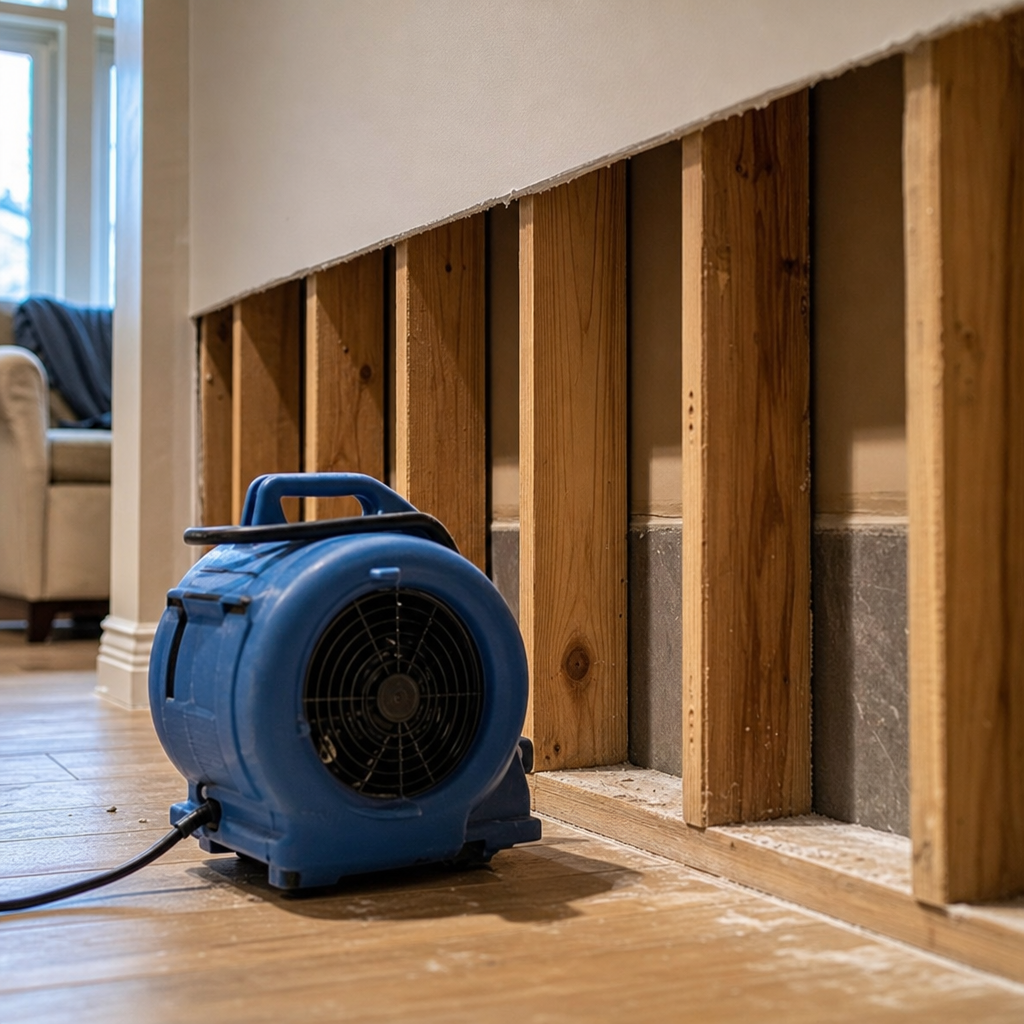
Porous materials like drywall absorb moisture quickly. In multi-family buildings and attached row houses, water can also migrate along structural framing and into enclosed wall cavities.
Identifying Hidden Moisture Behind Walls
Moisture meters and thermal imaging tools are commonly used by professionals like Floodline Restoration Co. to locate trapped water within wall assemblies. Identifying damp areas early allows for targeted drying of framing and insulation.
Addressing Saturated Materials
Depending on the category of water and extent of saturation, materials may be dried in place or partially removed to allow adequate airflow and complete drying of interior framing.
Drying and Salvaging Hardwood, Subfloors, and Structural Joists
Wood flooring and structural subfloors absorb water and can distort when wet. Prompt extraction and specialized drying procedures help remove moisture from deep within flooring layers and subflooring assemblies.
Subfloor and Floor Joist Care
Water standing on subfloors can seep into floor joist cavities and ceilings below. Consistent drying and moisture monitoring by teams such as Floodline Restoration Co. help ensure structural framing returns to acceptable moisture levels.
Category 3 Sewage Backup Cleanup and Basement Extraction
Water from sewer backups contains harmful contaminants and requires specialized handling and sanitization procedures.
Sanitization and Safety Measures
Sewage cleanup involves proper personal protective equipment, containment, the removal of non-salvageable porous items, and thorough cleaning and sanitization of affected structural surfaces.
Frequently Asked Questions About Water Damage Insurance Claims
What factors influence the cost of water damage cleanup?
Costs vary depending on the square footage affected, the source and cleanliness of the water, and whether structural drying or material replacement is required. Actual settlement amounts depend on your policy coverage and deductible.
Should I call my insurance company or a restoration contractor first?
Professionals at Floodline Restoration Co. advise that you should take immediate reasonable steps to stop the water flow and mitigate further damage, and notify your insurer promptly to report the loss and open your claim.
Does insurance cover mold remediation after a pipe burst?
Mold remediation may be covered when directly caused by a covered event, but exclusions, limits, and policy conditions vary; flood insurance has separate limitations and generally does not cover mold under the NFIP.
What should I confirm with a restoration contractor?
Ensure the contractor carries appropriate general liability insurance, possesses experience with structural drying and water mitigation, and provides clear, itemized documentation of all work performed.
Need homeowners insurance water damage cleanup?
We’re available now - call for a fast, free estimate.
Sources
- The Reauthorization of the National Flood Insurance … – congress.gov (2050)
- [PDF] national flood insurance program – media toolkit – Agents Floodsmart – agents.floodsmart.gov (2025)
- Don't Let Frozen Pipes Become Your Next Insurance Claim – mass.gov (2024)
- Closing the Flood Insurance Gap – congress.gov (2024)
- LexisNexis Risk Solutions Home Trends Report – risk.lexisnexis.com (2026)
Related reading: Water Extraction Cost Per Square Foot | 10% Off & Free Estimate | Same-Day Service
Related reading: Water Mitigation Cost Per Square Foot – 10% Off & Free Estimate – Same-Day Service
Related reading: Flood Cleanup Cost – Call Now-10% Off – Same-Day Service – Free Estimate
Frequently Asked Questions
How does direct insurance billing work for emergency water damage cleanup?
Through offerings like the Straight Claim Program at Floodline Restoration Co., the restoration contractor creates carrier-ready line-item documentation and submits invoices directly to your insurer. This direct coordination minimizes your out-of-pocket expenses beyond your policy deductible and prevents reimbursement delays.
How do insurance adjusters verify hidden water damage inside walls and subfloors?
Insurers require verifiable technical evidence such as infrared thermal imaging and moisture meter logs to approve structural drying inside cavities. Floodline Restoration Co. documents these exact moisture mapping metrics during inspections to substantiate the complete scope of hidden damage to your adjuster.
How quickly must emergency water extraction begin to satisfy policy requirements?
Insurance policies require policyholders to take reasonable mitigation steps within 24 to 48 hours to prevent secondary issues like mold growth and structural decay. Contacting a 24/7 team like Floodline Restoration Co. immediately fulfills your contractual duty to protect the property while preserving essential evidence.
About the author
 |
Christopher Vance Christopher Vance brings over 12 years of hands-on experience in water mitigation and structural drying, holding multiple certifications from the Institute of Inspection, Cleaning and Restoration Certification (IICRC). Before shifting his focus to consumer education, he managed large-loss commercial and residential recovery operations throughout the New York metropolitan area. He specializes in breaking down complex restoration processes and pricing models to help property owners make informed decisions during high-stress situations. |
Water damage, flood, or mold emergency?
We’re available now - call for a fast, free estimate.
Call Now - Free Estimate