
Quick Summary
Learning how to dry hardwood floors after water leak incidents requires immediate extraction and steady, balanced moisture control to prevent permanent plank cupping, mold growth, and subfloor damage. Floodline Restoration Co. emphasizes that while surface cleanup is essential in the first hour, fully saving structural subfloors from buckling requires advanced techniques like commercial LGR dehumidification and negative-pressure drying mat systems. Readers will understand how to accurately map hidden moisture depths and can call Floodline Restoration Co. for a free visual inspection and advanced moisture assessment before irreversible warping develops.
How to Dry Hardwood Floors After Water Leak Fast: Pro Guide
When you need to figure out how to dry hardwood floors after water leak events, the clock starts immediately. Standing water soaks into the wood fibers, seeps through tongue-and-groove seams, and collects in the subfloor below. If you act quickly with the right extraction and drying methods, you can often save the floor without tearing out original boards or dealing with long-term moisture problems.[4]
The goal is to bring the wood moisture content back to its normal baseline level. That baseline depends on your local climate and indoor conditions. As technicians at Floodline Restoration Co. point out, getting deep moisture out of solid planks and subfloor assemblies requires steady, balanced drying, calibrated moisture meters, and specialized drying systems designed to draw moisture upward through the floor.[3]
Fast Water Leak Response: What to Do in the First 60 Minutes
First 60 minutes checklist: Shut off the water source immediately, get standing puddles off the wood with a wet vacuum, and start low-grain refrigerant (LGR) dehumidifiers. Excessive heat can damage hardwood; controlled airflow, dehumidification, and careful monitoring support drying. Assess the surface, backing or core when applicable, and subfloor with a moisture meter in multiple locations because surface readings alone may miss intrusion.[2]
Water moves fast across hardwood. In pre-war row houses and apartment buildings with older oak flooring, water slips through perimeter expansion gaps and plank joints within minutes. Stopping the leak and pulling bulk water off the surface right away minimizes the amount of liquid that gets down into the joist cavities.
Immediate Action Checklist
- Kill the water supply: Locate the fixture shutoff or turn off the main water valve to the unit or building.
- Extract standing water: Use a commercial wet vacuum to pull liquid out of low spots and along plank seams. Keep room temperatures controlled and moderate; excessive heat can damage hardwood.
- Check the subfloor: Water trapped under the planks creates hidden dampness that standard household fans cannot reach.
Prompt water removal and rapid drying improve the likelihood of limiting damage and avoiding floor replacement.
What You Will Need to Dry Wet Wood Floors
Drying hardwood requires a system that balances evaporation with moisture removal. A standard shop vacuum and a household fan help with minor surface spills, but saturated tongue-and-groove planks need commercial equipment to pull water from underneath.
Essential DIY Tools vs. Professional Structural Equipment
For small, isolated spills caught within minutes, you can manage with a wet/dry vac, towels, a basic dehumidifier, and a wood moisture meter. For larger leaks from burst supply lines, dishwasher overflows, or radiator failures, structural restoration gear may be necessary:
- Negative-pressure floor mat systems: One possible professional technique where specialized mats are placed over the floor to help draw moisture from the assembly.
- Low-grain refrigerant (LGR) dehumidifiers: These units pull moisture out of the air even at low humidity levels, supporting drying throughout the space.
- Centrifugal air movers: Positioned to circulate dry air across the room without concentrating excessive heat directly onto the planks.
- Dual-depth moisture meters: Professional meters with probes to assess the surface, backing or core when applicable, and subfloor in multiple locations.
Rapid drying is important to protect wood flooring, and controlled airflow, dehumidification, and careful monitoring support drying while avoiding excessive heat that can damage hardwood.
Step 1: Stop the Water Source and Remove Surface Pools
You cannot make progress on how to dry hardwood floors after water leak damage until the water stops flowing. Surface puddles must be extracted immediately before liquid seeps into perimeter walls and baseboards.
Isolating the Leak
Check the likely culprits: a failed supply line under a sink, an overflowing toilet, an ice maker line, or a leaking radiator valve. If you cannot find the individual fixture shutoff valve quickly, go straight to the main water shutoff for the property.
Rapid Extraction Protocol
- Vacuum along the plank seams: Move the wet vacuum wand slowly parallel to the floorboards. The joints between boards act like gutters where standing water sits.
- Clear perimeter baseboards: In heavy leaks, water migrates to the edges of the room. Removing shoe molding or baseboards allows you to vacuum water directly out of the expansion gap.
Prompt water removal and rapid drying improve the likelihood of limiting damage to the flooring assembly.
Step 2: Map Hidden Moisture Across Planks and Subflooring
Need how to dry hardwood floors after water leak?
We’re available now - call for a fast, free estimate.
Never rely on touch or visual inspection to decide if a wood floor is dry. Planks can feel dry on top while holding moisture on their underside and in the subfloor.
Establishing an Unaffected Dry Standard
Before setting drying goals, grab a calibrated moisture meter and test hardwood in an unaffected room on the same floor level. This reading helps establish your target moisture level based on your indoor conditions.
Thorough Moisture Mapping
Assess the surface, backing or core when applicable, and subfloor in multiple locations because surface readings alone may miss intrusion. Documenting these numbers shows exactly where moisture spread and prevents premature equipment removal.
Step 3: Evaluate and Address Trapped Subfloor Water
Excessive heat can damage hardwood. Controlled airflow, dehumidification, and careful monitoring support drying rather than blasting high heat directly at the planks.
Controlled Drying Considerations
To safely address trapped moisture beneath hardwood, professional restorers like Floodline Restoration Co. may use negative-pressure drying mats as one possible technique. These panels are sealed over the wet floorboards to draw moisture out of the assembly without forcing you to rip up wood.
Drying Assembly Research
Controlled flood-house research found multiple drying methods effective under the tested conditions, with effectiveness varying by circumstance.
Step 4: Establish Continuous Dehumidification and Controlled Airflow
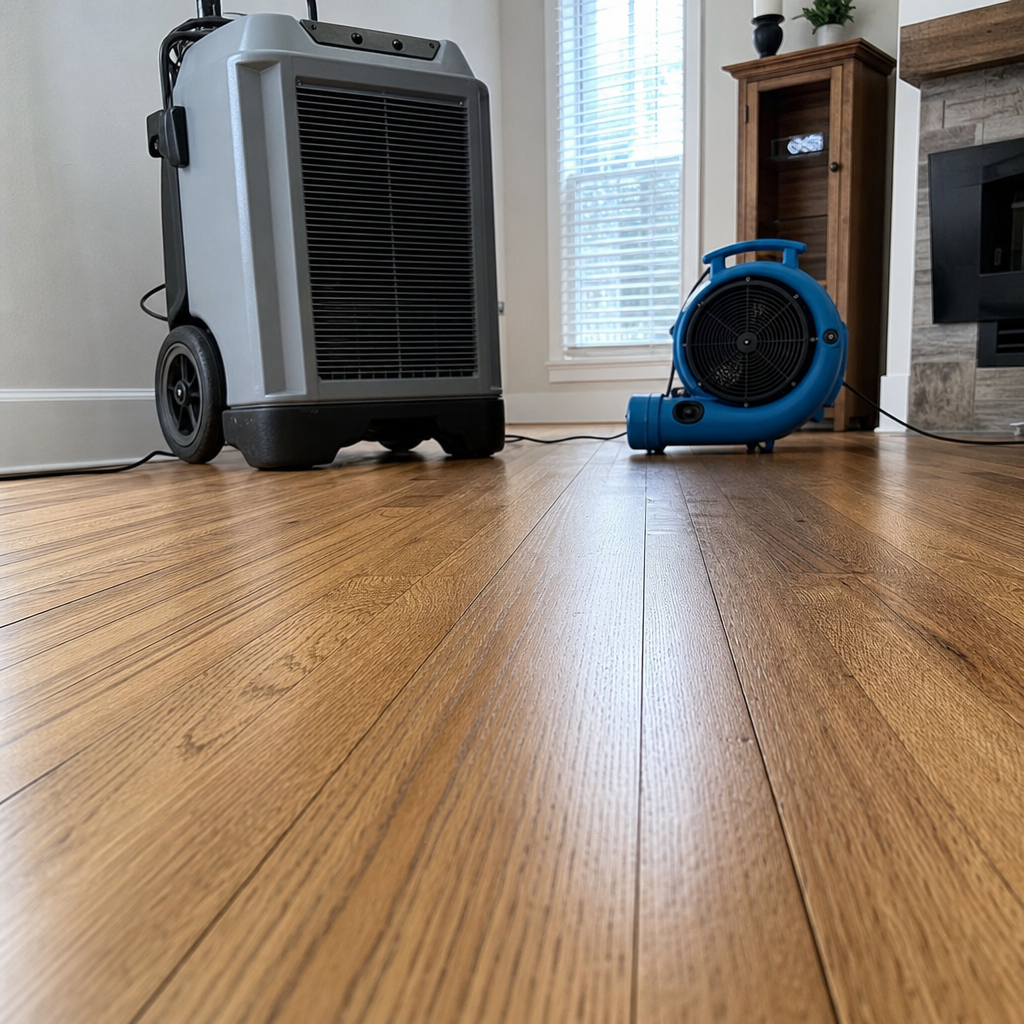
Drying wood is a process of managing vapor pressure. You need the air above the floor to be drier than the moisture inside the wood, creating conditions that draw water out.
Balancing Indoor Conditions
Run commercial LGR dehumidifiers continuously in the enclosed space. Keep indoor air temperatures controlled and moderate, avoiding excessive heat that can damage hardwood.
Airflow Management
Position air movers to circulate dry air across the room rather than concentrating high heat directly onto the floor surface. Controlled airflow, dehumidification, and careful monitoring support drying.
Step 5: Monitor Daily Moisture Logs Until Wood Reaches Equilibrium
Drying time varies with the amount of water, flooring and subfloor construction, temperature, humidity, and airflow. Expect days rather than hours, and continue monitoring until the flooring and subfloor stabilize.
Tracking Drying Curves
Take moisture readings at your established test locations at the same time each day. You should see a steady downward trend in moisture levels across the surface, core, and subfloor.
Preventing Post-Drying Issues
- Track test points: Continue drying until all test points read within 2 percentage points of the expected in-use moisture content.
- Check expansion gaps: Ensure the perimeter edges around baseboards are dry and clean to prevent moisture from lingering behind the trim.
Managing Subfloor and Joist Water Damage
Need how to dry hardwood floors after water leak?
We’re available now - call for a fast, free estimate.
When a leak occurs on an upper floor or over a basement, gravity pulls water straight down through the subfloor into the ceiling cavity below. If left unaddressed, damp structural joists can suffer structural degradation.
Symptoms of Trapped Subfloor Water
Look for signs that water made it past the subfloor:
- A spongy or bouncy feel when walking across the floor.
- Persistent musty odors that linger even after surface water is gone.
- Water stains, bubbling paint, or damp drywall on the ceiling directly underneath the wet floor.
Evaluation of Structural Members
If you have access to an unfinished basement or crawlspace below the leak, inspect the underside of the subfloor and joists. According to Floodline Restoration Co., setting up dehumidification from below while managing the floor above supports drying across the entire assembly.
Cupping, Crowning, and Buckling: Hardwood and Laminate Floors Recovery
When hardwood planks absorb water, the bottom of the board expands faster than the top. This forces the edges of the plank upward, creating a washboard effect known as cupping.
Will Cupped Hardwood Floors Flatten Back Out?
Yes, cupped solid hardwood floors often flatten out once the bottom of the plank and the subfloor reach moisture equilibrium with the rest of the room. This can take several weeks after the drying equipment is removed. Never sand or refinish a cupped hardwood floor while it is still wet. If you sand the raised edges flat while the bottom is swollen, the boards will crown (turn convex with high centers) once they completely dry, ruining the floor permanently.
Material Responses to Saturation
Different floor types respond differently to water:
- Solid Hardwood (Oak, Maple, Pine): Highly resilient. Can often be saved if dried promptly under controlled conditions.
- Engineered Hardwood: Has a real wood veneer over a manufactured core. Can often be dried if addressed promptly, though severe moisture exposure may compromise internal layers.
- Laminate Flooring: Made of compressed fiberboard layers that can swell when exposed to water, requiring careful inspection to evaluate damage.
Factors Influencing Hardwood Floor Restoration
Several variables dictate whether your floor can be restored in place:
- Time Elapsed: Prompt water removal and rapid drying improve the likelihood of limiting damage.
- Subfloor Construction: The type of subfloor and how it was constructed affect how moisture moves through the assembly and how long drying takes.
Frequently Asked Questions About Hardwood Floor Water Damage
Can wet hardwood floors be saved without tearing them out?
Yes. Prompt water removal and rapid drying improve the likelihood of limiting damage. Professional drying systems, such as those deployed by Floodline Restoration Co., including negative-pressure mats as one possible technique, can often dry planks and subfloors in place without demolition.
How long does it take for hardwood floors to dry out after a leak?
Drying time varies with the amount of water, flooring and subfloor construction, temperature, humidity, and airflow. Expect days rather than hours, and continue monitoring until the flooring and subfloor stabilize.
How do you pull moisture out from beneath hardwood floorboards?
Negative-pressure floor mats are one possible professional technique. These mats are sealed over the floor to help draw moisture from beneath the planks and subfloor.
Will cupped wood floors flatten out after drying?
In most cases, solid wood boards flatten out once the moisture content equalizes between the top and bottom of the wood. Allow several weeks of natural stabilization after drying before deciding whether any cosmetic refinishing is needed.
How do you prevent mold from growing under wet hardwood floors?
Rapid drying is the goal for wooden surfaces, and dehumidifiers, fans, and gentle heat can help; use heat carefully on hardwood.[1]
When should you call a professional water damage restoration service?
Call a professional if water covers more than a small surface area, if water seeped into walls or the ceiling below, if you notice significant cupping, or if the floor remains damp after initial DIY effort. Professional crews have moisture meters and specialized structural drying equipment needed to help save the floor.
Need how to dry hardwood floors after water leak?
We’re available now - call for a fast, free estimate.
Sources
- Chapter 4 – epa.gov (2008)
- Mold Course Chapter 2: | US EPA – 19january2021snapshot.epa.gov (2021)
- www.fpl.fs.usda.gov › documnts › fplgtrWood Handbook–Chapter 12–Drying and Control of Moisture Content… – fpl.fs.usda.gov
- WOOD FLOORING INSTALLATION GUIDELINES – nwfa.org – nwfa.org
Related reading: Certified Mold Remediation Elmhurst Ny – 10% Off & Free Estimate – Same-Day Service
Related reading: Sewage Cleanup Elmhurst | Call Now-10% Off | Same-Day Service | Free Estimate
Frequently Asked Questions
How long should I wait to refinish or sand hardwood floors after water damage drying?
You should wait several weeks after active drying finishes until the wood fully stabilizes to its normal baseline moisture level. Sanding cupped boards while their undersides are still swollen leads to permanent crowning once they fully dry. Floodline Restoration Co. offers moisture assessments to verify planks and subfloors have equalized before any sanding begins.
How is subfloor and joist moisture handled if water leaked to the ceiling below?
Drying multi-level structural assemblies requires simultaneous extraction from above using negative-pressure mats and continuous dehumidification from the basement or ceiling cavity below. Floodline Restoration Co. inspects and maps joist cavities to pull trapped water out before framing rots or mold colony growth starts.
How can I document hidden subfloor water damage for an insurance claim?
Insurance claims require documented comparative readings taken with dual-depth moisture meters against an unaffected baseline room. Floodline Restoration Co. provides comprehensive visual inspections and daily moisture tracking logs that prove hidden saturation within the subfloor layers.
About the author
 |
Christopher Vance Christopher Vance brings over 12 years of hands-on experience in water mitigation and structural drying, holding multiple certifications from the Institute of Inspection, Cleaning and Restoration Certification (IICRC). Before shifting his focus to consumer education, he managed large-loss commercial and residential recovery operations throughout the New York metropolitan area. He specializes in breaking down complex restoration processes and pricing models to help property owners make informed decisions during high-stress situations. |
Water damage, flood, or mold emergency?
We’re available now - call for a fast, free estimate.
Call Now - Free Estimate