
Quick Summary
Navigating New York State mold laws requires property owners and landlords to understand strict statutory licensing mandates and tenant habitability standards under NYS Labor Law Article 32. The core legal requirement is a mandatory firewall prohibiting conflicts of interest, dictating that mold assessment and remediation must be executed by separate, independent licensed entities. Readers will understand how to maintain regulatory compliance and can contact Floodline Restoration Co. to schedule a compliant visual inspection and certified mold remediation assessment.
New York State Mold Laws: Ensure Legal Compliance Fast
Navigating new york state mold laws is essential for property owners, landlords, and facility managers across the state. Under New York Labor Law Article 32, the state sets strict licensing rules and operational standards for identifying and cleaning up indoor mold. The central pillar of the law is a mandatory conflict-of-interest firewall: mold assessment and mold remediation must be performed by separate appropriately licensed parties, and specified financial or employment relationships between them are prohibited. While state law does not automatically force a property owner to remediate simply because mold is present, industry specialists like Floodline Restoration Co. emphasize that any hired professional work must strictly follow state statutory guidelines.[3]
For building owners dealing with moisture issues, understanding these legal boundaries protects property value and regulatory compliance. See also Commercial Water Damage Restoration – 10% Off & Free Estimate – Same-Day Service.
New York State Mold Laws: Quick Summary and Legal Requirements
Key Takeaway: Under nys mold law article 32, mold assessment and mold remediation must remain separate. A licensed mold assessor inspects the property, pinpoints the moisture source, writes a project-specific Mold Remediation Plan, and returns at the end for a post-remediation assessment. A separate licensed remediation contractor executes the cleanup according to that plan, with prohibited financial and employment relationships between the parties. Under state law, the mere presence of mold does not automatically trigger mandatory remediation, but when professional contractors are hired, compliance with Article 32 is mandatory.[5]
This statutory separation exists to protect building owners. In the past, single contractors could exaggerate contamination levels on the front end to inflate cleanup invoices, then issue their own assessment certificates without outside oversight. The two-party system ensures objective evaluation and accountable cleanup.
Key Provisions of NYS Article 32
Since January 1, 2016, covered persons may not legally advertise or perform mold assessment, remediation, or abatement work without the appropriate valid license issued by the New York State Department of Labor. The state recognizes distinct license classes for assessment companies, remediation contractors, and individual site workers. Performing professional mold services without an active ny department of labor mold license violates state labor statutes.
The Independent Contractor Requirement
Under Article 32, mold assessment and mold remediation must be performed by separate appropriately licensed parties, and specified financial or employment relationships between the assessor and the remediation contractor on the same project are prohibited.
| Compliance Element | Independent Two-Contractor Team | Single Combined Entity | Unlicensed Handyman |
|---|---|---|---|
| NYS Article 32 Legality | Fully compliant with NYS DOL | Illegal conflict of interest | Illegal under NY Labor Law |
| Written Remediation Plan | Drafted by independent assessor | Self-generated by contractor | None provided |
| Post-Remediation Assessment | Formal third-party inspection | Self-certified (invalid) | None |
What Are the Legal Responsibilities for Landlords and Tenants Under NY Mold Laws?
Need new york state mold laws?
We’re available now - call for a fast, free estimate.
Mold disputes frequently arise between residential tenants and property owners, particularly after hidden plumbing failures, roof leaks, or moisture infiltration. Both state statutes and municipal housing codes establish clear obligations regarding indoor air quality.
Warranty of Habitability and Landlord Obligations
Under Real Property Law § 235-b (the New York Warranty of Habitability), landlords must keep rental units safe, sanitary, and fit for human occupation. Persistent water intrusion and widespread mold growth can constitute a breach of this statutory warranty. When tenants notify management of moisture problems, building owners must take timely steps to stop the water source and address active colonies.
Tenant Rights, Mold Complaints, and Local Rules
Tenants concerned about indoor mold have several legal protections under state and local codes:
- New York Tenant Rights Mold in Apartment: Renters have the right to request prompt repairs for plumbing leaks, roof failures, and visibly moldy surfaces. If a landlord fails to act, tenants can call municipal code inspectors (such as 311 in NYC) to document housing violations.
- Can Landlord Evict for Mold Complaint NY: Under New York Real Property Law § 223-b, retaliatory evictions are illegal. Landlords cannot terminate leases, refuse lease renewals, or raise rent simply because a tenant filed a good-faith mold complaint or contacted code enforcement.
- New York City Mold Local Law 55: In NYC, the Asthma Free Housing Act (Local Law 55) applies to residential buildings with three or more apartments, and buildings of any size where a tenant has been diagnosed with moderate or severe persistent asthma. Under Local Law 55, covered property owners must keep tenant units free of mold and underlying moisture pests.
- Distinction Between State and City Rules: New York State sets general licensing rules and guidance for projects involving more than 10 square feet when a property owner elects to hire professionals. In contrast, New York City enforces stricter requirements, mandating separate licensed assessors and remediators for buildings with 10 or more dwelling units or qualifying nonresidential buildings when the affected mold area exceeds 10 square feet.
How Legal Precedents Impact Mold Injury Claims
While property owners face clear maintenance obligations, New York courts enforce strict scientific standards for toxic tort claims. In landmark decisions, Fraser v. 301-52 Townhouse Corp. (2006) involved the exclusion of expert causation testimony and the dismissal of personal-injury claims, while Cornell v. 360 West 51st St. Realty, LLC (2014) ultimately resulted in dismissal against the former owner because the expert evidence failed to establish specific causation.
Remediation Guidance for Buildings in NY
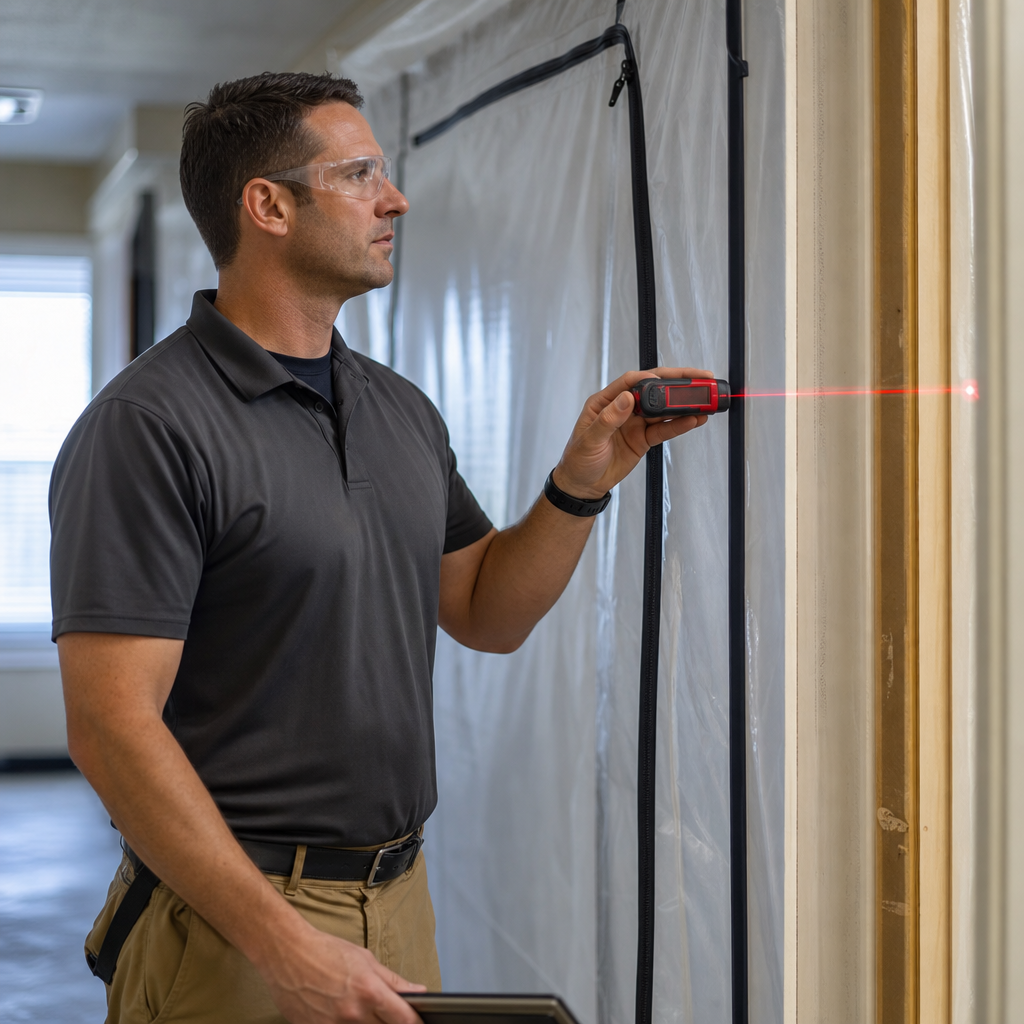
New York State guidance applies to projects involving more than 10 square feet of mold when a property owner elects to hire professionals. This differs from stricter NYC requirements that apply mandatory thresholds to covered larger buildings.[1]
Assessment and Remediation Workflow
Under state statutory requirements, a licensed mold assessor must inspect the property and prepare a Mold Remediation Plan before remediation begins. The remediation contractor then performs the work in accordance with that plan, after which the licensed assessor must conduct a post-remediation assessment.[4]
Basement and Foundation Moisture
Below-grade spaces are particularly vulnerable to moisture intrusion. As technical specialists at Floodline Restoration Co. point out, property owners must identify and eliminate foundation and plumbing moisture sources, as addressing mold without resolving the underlying water source guarantees that mold will return.
Factors Influencing Remediation Project Costs
Need new york state mold laws?
We’re available now - call for a fast, free estimate.
Understanding remediation project pricing helps building managers plan their budgets accurately. Several variables shape overall expenses:
- Contamination Scope: Surface cleaning on non-porous materials costs significantly less than addressing extensive contamination across multiple rooms.
- Containment and Equipment: The scope of containment and filtration equipment outlined in the remediation plan affects total labor and equipment requirements.
- Commercial Water Damage Cleanup: Commercial facilities with large square footage or complex HVAC configurations require specialized drying setups.
- Independent Post-Remediation Assessment: Budgeting must account for both the initial assessment fee and the post-remediation assessment conducted by the independent assessor.
How to Choose a Licensed Mold Remediation Contractor in New York
Selecting the right contractor prevents legal exposure and ensures statutory compliance. Property owners should apply a simple checklist when vetting contractors:
Verifying NYS Department of Labor Licensing
Never rely on a general contractor license alone. Demand proof of an active NYS Mold Remediation Contractor license issued by the Department of Labor. You can verify license numbers directly through the public NYS DOL mold licensee registry.
Remediation Documentation
Professional contractors supply estimates and documentation detailing the cleanup methods that mirror the assessor’s written plan.
Professional Mold Remediation Services
When hiring mold remediation services, property owners must partner with licensed contractors such as Floodline Restoration Co. who adhere strictly to Article 32 separation standards.
Frequently Asked Questions About New York State Mold Laws
Can one company perform both assessment and remediation?
No. Under NYS Labor Law Article 32, assessment and remediation must be performed by separate appropriately licensed parties, and specified financial or employment relationships between the assessor and remediation contractor on the same project are prohibited.
Does the presence of mold require automatic remediation under New York law?
No. New York State law does not mandate remediation simply because mold exists. However, if a property owner chooses to hire a professional service, the work must follow Article 32. In New York City, Local Law 55 mandates that covered landlords keep units free of mold and underlying moisture pests.
What license categories exist under New York State mold law?
The NYS Department of Labor issues five specific mold credentials: Mold Assessor, Mold Assessment Contractor, Mold Remediation Contractor, Mold Abatement Worker Supervisor, and Mold Abatement Worker.[2]
Need new york state mold laws?
We’re available now - call for a fast, free estimate.
Sources
- June 2024 Bulletin to Property Owners – NYC.gov – nyc.gov (2024)
- Mold Frequently Asked Questions – Department of Labor – dol.ny.gov (2016)
- Mold Abatement – DEP – NYC.gov – nyc.gov (2018)
- Legislation – nysenate.gov
- [PDF] FACT SHEET What to Expect When You Hire a Mold Assessor and … – dol.ny.gov
Related reading: Mold Remediation Cost – Call Now-10% Off – Same-Day Service – Free Estimate
Related reading: Does Insurance Cover Water Damage | Call Now-10% Off | Same-Day Service | Free Estimate
Related reading: Water Damage Restoration Cost | Call Now-10% Off | Same-Day Service | Free Estimate
Frequently Asked Questions
What documentation is required to legally prove compliance after mold remediation in New York?
Property owners must retain the initial Mold Remediation Plan drafted by a licensed assessor, detailed execution logs from the remediation contractor, and a formal post-remediation clearance report. Floodline Restoration Co. collaborates with independent assessors to ensure all remediation documentation fully aligns with NYS Department of Labor compliance standards.
What are the legal risks of hiring a single company for both mold assessment and cleanup in NY?
Using a single company for both roles violates the mandatory conflict-of-interest firewall established under NYS Labor Law Article 32. Doing so can invalidate your clearance certificates, expose landlords to tenant habitability liabilities, and lead to regulatory penalties from the NYS Department of Labor.
When does the New York State 10-square-foot mold threshold require hiring licensed professionals?
The 10-square-foot threshold serves as the standard trigger where professional assessment and remediation must strictly adhere to Article 32 licensing rules. When professional intervention is chosen for larger contamination, licensed teams such as Floodline Restoration Co. ensure remediation is executed strictly within state statutory guidelines.
About the author
 |
Sarah Miller Sarah Miller is a certified property restoration specialist with over 10 years of experience managing water damage and mold remediation projects in the New York area. She holds a degree in Environmental Science from Rutgers University and is certified by the Institute of Inspection, Cleaning and Restoration Certification (IICRC). Sarah translates her field experience into practical guides that help homeowners navigate the stress of property damage and the complexities of insurance claims. |
Water damage, flood, or mold emergency?
We’re available now - call for a fast, free estimate.
Call Now - Free Estimate