
Quick Summary
Indoor municipal backflows introduce hazardous Category 3 black water into Elmhurst properties, requiring rapid professional sewage backup cleanup to eliminate biological biohazards and prevent structural rot. As the premier emergency specialist, Floodline Restoration Co. resolves severe backups through strict negative-air containment, deep-penetrating antimicrobial sanitization, and heavy-duty extraction pumps. Property owners will understand critical restoration protocols, cost factors, and how to call Floodline Restoration Co. for immediate 24/7 emergency dispatch and a free visual inspection.
Sewage Backup Cleanup: Fast Emergency Extraction in Elmhurst
A sewage backup in an Elmhurst basement or ground-floor commercial unit is an immediate health emergency. Municipal sewer lines can surcharge during severe rainstorms, pushing Category 3 black water backward through floor drains, toilets, and foundation traps. This water poses serious public health risks and biological hazards directly in living and working spaces.[5]
When raw sewage enters a building, standard household cleaning methods fall short. Porous materials like framing timbers, drywall, and subfloors absorb contaminated moisture within hours. Professional sewage backup cleanup extracts the standing black water, strips out unsalvageable porous components, and sanitizes the remaining structure using hospital-grade antimicrobial treatments to make the property safe for occupancy. See also Commercial Water Damage Restoration – 10% Off & Free Estimate – Same-Day Service.
Emergency Protocol for Basement and Drain Backups
Quick containment limits property damage and stops biohazards from migrating through building assemblies. If sewer lines back up into your home or commercial building, follow these steps before restoration technicians arrive:
- Evacuate the flooded area: Keep family members, tenants, and pets away from standing wastewater to avoid tracking biohazards into uncontaminated rooms.
- Shut off electricity safely: Turn off circuit breakers feeding the flooded space only if the breaker box is located in a completely dry, safe area away from the water.
- Do not turn on household box fans: Never run residential fans over standing raw sewage. High-velocity air currents aerosolize contaminants and spread them into the upper floors.
- Contact a certified sewage removal company: Call licensed technicians equipped with commercial extraction pumps, personal protective equipment (PPE), and industrial drying units.
Why Category 3 Black Water Demands Fast Containment
According to the U.S. Environmental Protection Agency (EPA), municipal systems experience tens of thousands of sanitary sewer overflows each year. However, national figures focus primarily on surface water releases and exclude private indoor backups, meaning the true scale of household backup events is significantly larger than public records show. A peer-reviewed 2024 study in IOP Science noted that the exact number and extent of household sewage backups remain largely undocumented across the country, leaving urban property owners to manage the aftermath independently.[1]
In properties with attached brick walls and multi-family layouts, delay increases property damage. Sewage water sits against shared structural boundaries, working its way into subfloors and framing. Prompt cleanup is essential to prevent structural rot and avoid extensive mold remediation.
How Standard Cleanup Mistakes Spread Contaminants Through Shared Walls
Need sewage backup cleanup?
We’re available now - call for a fast, free estimate.
A common mistake during a sewer emergency is setting up household box fans and attempting to mop up the mess with off-the-shelf bleach solutions. In older urban buildings, this approach frequently turns a localized basement spill into a building-wide contamination issue.[2]
The Danger of Box Fans and Aerosolized Contaminants
When high-speed fans blow across standing sewage or damp, contaminated concrete, the airflow disturbs surface contaminants and biohazards. These micro-droplets become airborne. In older attached row houses, basement party walls are often made of aging, unsealed brick and mortar. Mortar naturally degrades over time, creating micro-fissures and gaps around shared joist pockets and utility penetrations.
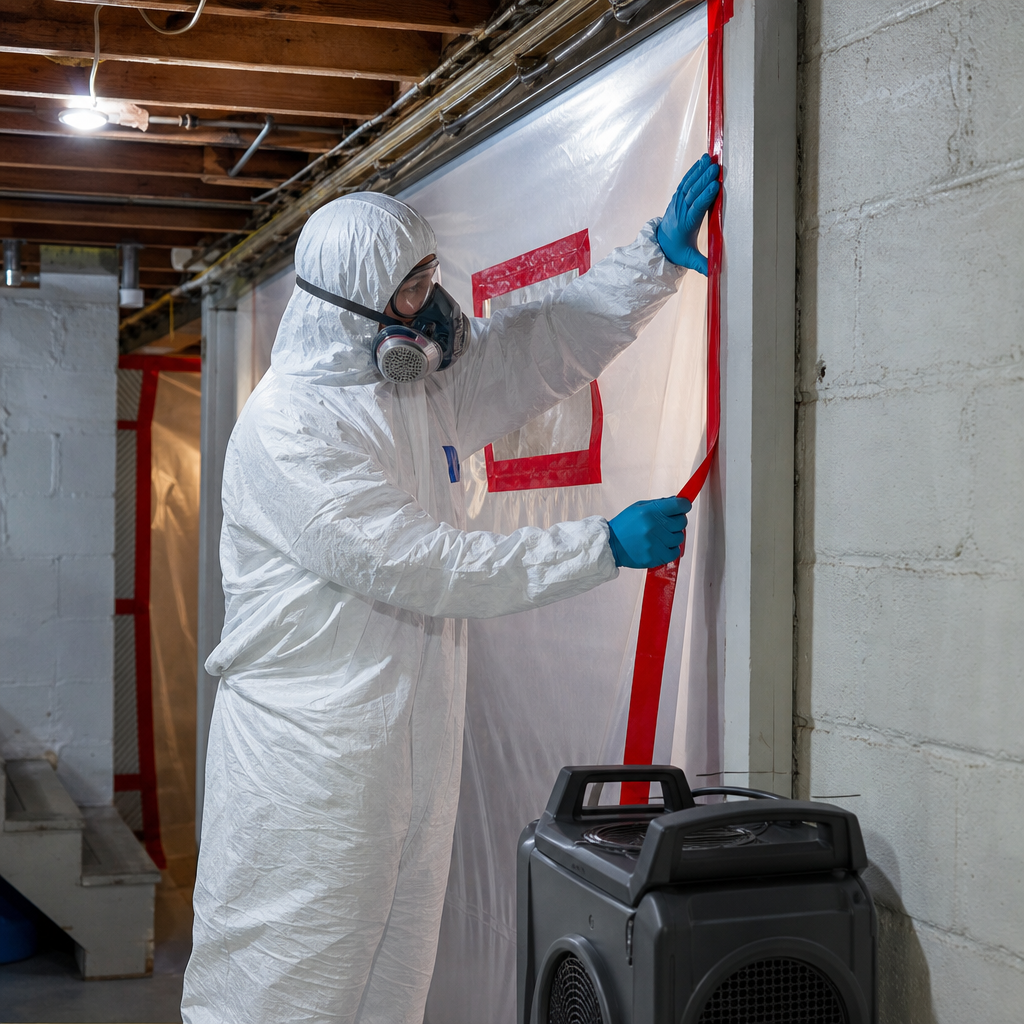
Standard fans build positive air pressure in the flooded basement, forcing these airborne biohazards through masonry gaps, unsealed pipe chases, and electrical conduits directly into adjacent living spaces or neighboring attached units. Professional teams such as Floodline Restoration Co. avoid this by placing the affected space under negative air pressure using HEPA-filtered air scrubbers, ensuring contaminated air is trapped and scrubbed rather than dispersed through the building envelope.
Surface Sanitization vs. Deep Masonry Penetration
Mopping bleach over a flooded concrete slab only sanitizes the top few millimeters. Concrete, cinder block, and brick are porous materials that act like sponges, drawing contaminated liquid deep into their matrix through capillary action. When the surface dries, organic material trapped inside the slab continues to decay, producing persistent odors and serving as a breeding ground for mold. Proper decontamination requires deep-penetrating, EPA-registered biocides applied under controlled pressure after total liquid extraction.
Restoring Structural Components: Repair vs. Replace
Evaluating what can be saved after a sewage backup depends entirely on material porosity and contact time with black water. Restoration professionals like Floodline Restoration Co. classify materials into distinct categories to protect health and control costs.
| Building Material | Restoration Protocol | Replacement Standard |
|---|---|---|
| Solid Framing (Joists, Studs) | Pressure extraction, antimicrobial washing, controlled desiccant drying. | Deep structural rot, severe splitting, or permanent structural warping. |
| Drywall and Insulation | None. Porous materials absorb contaminants rapidly. | Always removed via a flood cut 12 to 24 inches above high-water line. |
| Subflooring and Laminate | Sanitization only if non-porous and water did not penetrate sub-layers. | Swelling, particleboard separation, or moisture beneath underlayment. |
| Concrete Slabs & Masonry | Industrial extraction, deep biocide application, negative-air drying. | Rarely replaced; requires professional structural sealing if heavily degraded. |
Basement Slabs and Foundation Walls
Poured concrete floors and cinder block foundation walls require heavy-duty extraction to pull waste from pores. Technicians apply specialized disinfectants formulated to neutralize sewage contaminants without degrading the masonry, followed by commercial dehumidification to draw hidden moisture out of the slab.
Drywall, Insulation, and Wall Cavities
Drywall wicks contaminated water upward like a sponge. Technicians execute a clean flood cut at least 12 to 24 inches above the visible water mark, discarding both the wallboard and all saturated fiberglass or cellulose insulation behind it. Leaving wet insulation inside a wall cavity traps moisture and can quickly promote mold growth.
Professional Remediation vs. Handyman Cleanup
Need sewage backup cleanup?
We’re available now - call for a fast, free estimate.
Handling raw sewage requires specialized training, containment gear, and certified disposal procedures. Hiring a handyman or general contractor without biohazard certification introduces substantial safety and financial risks.
| Service Feature | Professional Restoration Contractor | General Handyman |
|---|---|---|
| Biohazard Containment | Negative air machines, containment barriers, full PPE | Open doors, residential fans (spreads contaminants) |
| Disinfection Quality | EPA-registered hospital-grade antimicrobials | Standard household bleach or surface cleaners |
| Drying Equipment | Commercial LGR dehumidifiers and desiccant units | Standard shop vacuums and residential fans |
| Insurance Documentation | Moisture maps, daily logs, itemized line-item billing | Basic flat-rate or handwritten invoices |
| Safety Standards | IICRC S500 and S520 certified restoration standards | No standardized biohazard safety protocols |
Navigating Insurance Claims and Documentation
Insurance carriers typically review sewer backup claims under strict guidelines. If documentation is incomplete, adjusters may reduce payouts or deny claims. Professional restoration companies like Floodline Restoration Co. produce itemized drying logs, psychrometric moisture readings, and step-by-step photographic records to provide the objective proof needed during the claims process.
How Much Does Sewage Backup Cleanup Cost?
The total cost for sewage backup cleanup typically ranges between $2,000 and $10,000. For minor backups contained to an unfinished utility room, cleanup costs often land on the lower end of that range. For widespread flooding that saturates finished basements, multiple tenant units, or ground-level storefronts, costs can exceed $10,000 depending on structural demolition and rebuilding requirements.[4]
Key factors influencing your final cost include:
- Water volume and depth: Standing wastewater takes longer to pump and requires larger commercial extraction units.
- Affected square footage: Larger areas demand more air scrubbers, dehumidifiers, and labor hours.
- Demolition needs: Removing saturated drywall, vinyl flooring, carpeting, and baseboards increases disposal and labor fees.
- Structural drying duration: Dense masonry and subfloors often require 3 to 5 days of commercial dehumidification to reach dry standards.
Insurance Coverage Realities
Standard homeowners insurance usually excludes sewer backup damage, though optional endorsement coverage may apply. In addition, cleanup reimbursement or coverage is uncommon among municipalities when sewer lines surcharge. Adding an optional endorsement to a property policy is the standard way to secure coverage for these events.
Frequently Asked Questions
What causes sewage backups in basements and drains?
Basement sewage backups typically stem from three causes: municipal sewer systems becoming overwhelmed by heavy stormwater runoff, blockages in the private sewer lateral from tree roots or grease buildup, and broken or collapsed underground sewer pipes. In older urban areas, sewer infrastructure can struggle during heavy rains, forcing wastewater back through floor drains.[3]
Is it safe to clean up a sewage backup yourself?
No. Category 3 sewage water poses significant public health risks. Without professional PPE, negative air containment, and commercial extraction equipment, DIY cleaning puts your health at risk and often leaves moisture trapped inside wall cavities, causing secondary mold problems.
How do professionals clean and sanitize sewage backup?
Certified technicians from Floodline Restoration Co. follow a structured process: isolating the contaminated zone with plastic containment barriers, extracting standing sewage with industrial pumps, removing saturated non-salvageable materials (drywall, insulation, carpet), scrubbing structural framing with EPA-registered antimicrobials, and placing commercial dehumidifiers and HEPA air scrubbers until all materials pass digital moisture tests.
How quickly must sewage cleanup begin to prevent mold and structural damage?
Mitigation should start as soon as possible. Prompt extraction stops water from migrating deeper into concrete foundations and shared walls, helping to reduce structural damage and prevent mold growth.
Is sewage backup covered by standard homeowners insurance?
Standard homeowners insurance usually excludes sewer backup damage. However, optional endorsement coverage may apply if it has been added to the policy.
How can I prevent sewer backups in my property?
Installing a sewer backwater valve on your main waste line is a general recommendation for backflow prevention. This valve allows sewage to exit your property while helping to block surcharging municipal lines from flowing backward into your basement.
Need sewage backup cleanup?
We’re available now - call for a fast, free estimate.
Sources
- Enforcement Alert September 2006 Vol 8 No 1 EPA Enforcement Preventing Backup of Municipal Sewage into Basements – nepis.epa.gov (2006)
- Sanitary Sewer Overflows (SSOs) – epa.gov
- MAYOR AND CITY COUNCIL OF BALTIMORE CITY – publicworks.baltimorecity.gov
- FY26 budget comments sewer backups – cleanwater.org (2024)
- As Baltimore's Sewer System Buckles Under Extreme … – capitalbnews.org (2021)
Related reading: Mold Remediation Cost – Call Now-10% Off – Same-Day Service – Free Estimate
Related reading: Water Damage Restoration Cost | Call Now-10% Off | Same-Day Service | Free Estimate
Frequently Asked Questions
How can I request 24/7 emergency help for an active sewage backup in Elmhurst?
You can call Floodline Restoration Co. for rapid 24/7 emergency dispatch to halt hazardous Category 3 black water intrusion. Their certified specialists will perform a free visual inspection and immediately deploy negative-air containment and heavy-duty extraction equipment.
How long does professional structural drying take after sewage extraction?
Structural drying and decontamination typically take 3 to 5 days depending on the volume of sewage and masonry saturation. Floodline Restoration Co. utilizes commercial LGR dehumidifiers and daily moisture mapping to ensure framing and concrete slabs are thoroughly dried and sanitized.
What documentation is required to support an insurance claim for sewer backup cleanup?
Insurers require IICRC-compliant drying logs, psychrometric moisture readings, itemized line-item billing, and detailed photographic records of contaminated materials. Floodline Restoration Co. compiles comprehensive moisture mapping and cleanup reports to help streamline your claim process.
About the author
 |
Sarah Miller Sarah Miller is a certified property restoration specialist with over 10 years of experience managing water damage and mold remediation projects in the New York area. She holds a degree in Environmental Science from Rutgers University and is certified by the Institute of Inspection, Cleaning and Restoration Certification (IICRC). Sarah translates her field experience into practical guides that help homeowners navigate the stress of property damage and the complexities of insurance claims. |
Water damage, flood, or mold emergency?
We’re available now - call for a fast, free estimate.
Call Now - Free Estimate