
Quick Summary
Understanding what water damage is covered by insurance hinges on distinguishing between sudden, accidental pipe failures and excluded gradual deterioration or exterior flood events. Standard property policies typically fund emergency extraction and structural repairs for abrupt internal plumbing breaks, while excluding long-term seepage, deferred maintenance, and unendorsed sewer backups. Property owners can consult Floodline Restoration Co. for professional visual inspections and IICRC-standard moisture documentation to substantiate their loss timeline and secure claim approval.
What Water Damage Is Covered by Insurance – Fast Claim Guide
Understanding what water damage is covered by insurance comes down to a fundamental rule: coverage generally applies to sudden and accidental plumbing discharges and other water damage specifically supported by the policy, subject to exclusions, deductibles, limits, and maintenance duties, while excluding damage caused by gradual wear, poor maintenance, or rising outdoor floodwater. If a pressurized copper pipe bursts inside your ceiling or a supply line snaps behind your washing machine, the resulting structural drying and repairs are typically covered. However, the policy covers the damage caused by the water, not the cost to replace the faulty appliance or worn-out plumbing part itself. According to data from the Insurance Information Institute, about 1 in 60 insured homes files a property claim for water damage or freezing each year, making it one of the most common property insurance claims.[2]
What Water Damage Is Covered by Insurance: Quick Loss Guide
Quick Loss Guide: Standard homeowners policies generally cover sudden, internal water events such as ruptured pipes, failed water heaters, and overflowing fixtures, subject to policy terms, limits, and deductibles. Commercial property policies may offer coverage depending on specific policy forms and endorsements. Policies typically do not cover slow leaks that developed over weeks or months, deferred maintenance, exterior floodwaters, or sewer backups (unless you have a specific sewer backup endorsement). When a covered event occurs, your insurer may pay for reasonable mitigation, extraction, structural drying, and repairing damaged structural materials, minus your deductible. See also Elmhurst Water Damage Restoration Costs | Call Now-10% Off | Same-Day Service | Free Estimate.
Insurance policies are written around perils, not outcomes. The National Association of Insurance Commissioners notes that sudden plumbing failures are covered as long as the property owner took reasonable steps to maintain heat and basic property care. When water damage occurs, adjusters investigate the physical evidence to determine the exact origin point and whether the loss stemmed from an internal failure or external water intrusion.[3]
Three Rules of Water Claim Approvals
- Sudden pipe splits and mechanical failures are covered: A ruptured supply line or cracked pipe meets the sudden-and-accidental standard. The insurer covers the cleanup and rebuilding of walls, floors, and ceilings, while the homeowner covers the minor plumbing repair that caused the break.
- Slow leaks, rot, and street-level floodwaters are excluded: Long-term moisture, deteriorating shower pans, and rainwater pooling on the street require separate flood insurance through the National Flood Insurance Program (NFIP) or private flood carriers.
- Objective moisture logs prove your timeline: Adjusters look for physical proof that damage happened immediately rather than over months. As specialists at Floodline Restoration Co. emphasize, detailed psychrometric drying logs and thermal imaging can help substantiate loss timelines directly with insurance adjusters.
Sudden vs. Gradual Damage: What Policies Actually Pay For
Need what water damage is covered by insurance?
We’re available now - call for a fast, free estimate.
The dividing line between a paid claim and a denial is the timeline of the loss. When an event happens in seconds or minutes, it is classified as sudden. When water slowly drips behind a wall cavity over months, adjusters classify it as continuous seepage or neglect, which standard policies exclude.
| Coverage Factor | Sudden Pipe Rupture | Gradual Seepage | Storm Surge / Flood |
|---|---|---|---|
| Standard Policy Coverage | Water damage to structure and contents may be covered under applicable policy terms | Excluded (Deemed maintenance or neglect) | Excluded (Requires separate flood policy) |
| Maintenance Requirement | Basic heat and reasonable care maintained | Unaddressed leaks disqualify coverage | Not applicable to standard policies |
| Mold Remediation Coverage | Policy-dependent and subject to applicable terms and limits | Excluded if mold stems from long-term humidity or slow leaks | Subject to specific flood policy terms |
Covered Perils: Split Pipes and Fixture Failures
According to the Insurance Information Institute, water damage and freezing account for nearly a quarter of all property damage claims annually. Common covered scenarios include a second-story copper line freezing and bursting during a winter cold snap, an ice maker line snapping while you are away at work, or an entire water heater tank suddenly rupturing in the utility room. In these instances, the policy funds emergency water extraction, antimicrobial treatment, dehumidification, and reconstruction of affected drywall and flooring.
Excluded Losses: Long-Term Seepage and Deferred Maintenance
If water drips from an old tub trap for three months, rotting the subfloor and ceiling joists below, coverage may be excluded when gradual leakage, neglect, or deferred maintenance caused or contributed to the loss. Policy language places an obligation on the property owner to inspect and maintain the building. When adjusters see black mold colonies, soft rotted wood, or mineral crusting on plumbing joints, they document those signs as evidence of pre-existing, unaddressed problems.
Does Insurance Cover Mold Cleanup?
Mold coverage is policy-dependent and more restricted than standard water damage coverage. If mold results from a sudden, covered water loss, remediation coverage depends on specific policy terms, conditions, and endorsements. If mold appears because of high basement humidity, a damp foundation wall, or an ignored window leak, insurance will not pay for the remediation.
The Origin Point Trap: Sewer Backups vs. Flood Damage
Basement water damage creates some of the most contentious insurance disputes. The issue centers on distinguishing municipal sewer backups from uncovered exterior surface flooding.
How City Sewer Backups Flood Basements
In older urban neighborhoods with combined sewer systems that carry both household waste and street runoff, intense rainstorms can overwhelm city mains. The excess volume can create hydrostatic backpressure, pushing sewage and stormwater back through lateral lines and up through basement drains, sinks, and low-lying fixtures, though specific local drainage conditions require independent verification.
Why Adjusters Investigate Backups and Surface Flooding
FEMA estimates that roughly 40% of National Flood Insurance Program claims originate outside designated high-risk flood zones. When investigating a flooded basement after a storm, adjusters must determine whether water entered through foundation cracks and window wells (which is excluded under standard homeowners policies) or through internal plumbing fixtures, which may be covered under an optional sewer backup rider.[1]
Understanding the Water Backup and Sump Discharge Rider
Standard property policies specifically exclude sewer and drain backups. Protection against this disaster requires adding a Water Backup and Sump Discharge endorsement to your policy. Even with this rider in place, coverage depends on the specific terms of the endorsement and the verified cause of the backup.
Damaged Building Materials: Repair vs. Replacement Rules
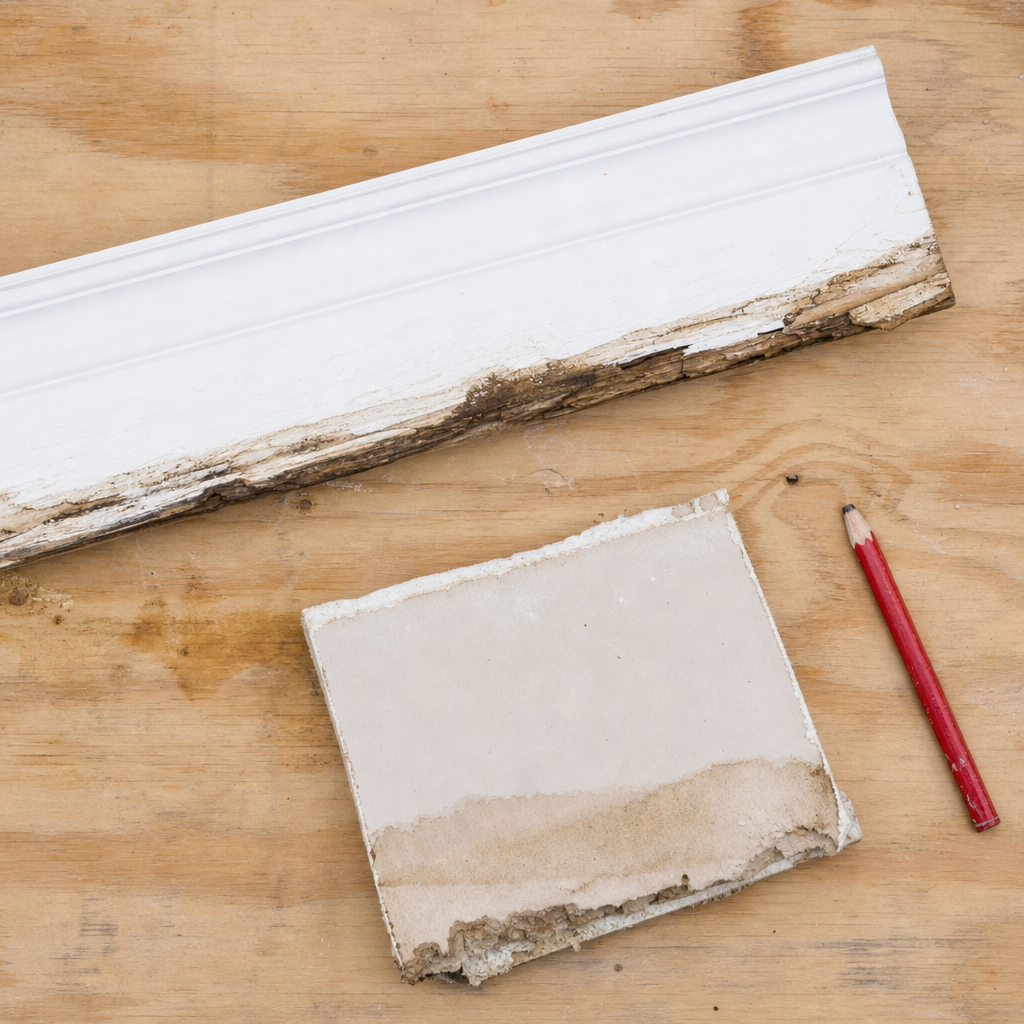
When a claim is accepted, reasonable restoration costs may be covered for a covered event, subject to policy terms, limits, and deductibles. How materials are handled depends on the clean-water category of the loss and the porosity of the building materials.
Drywall, Ceilings, and Shared Masonry Walls
In attached multi-unit properties and brick row houses, water rarely stays confined to one area. Moisture wicks through plaster, sheetrock, and shared brick party walls. Drywall saturated with clean water can occasionally be dried if addressed within 24 hours, but sheetrock exposed to contaminated water or Category 3 black water must be cut out at least two feet above the high-water mark and discarded.
Hardwood Floors, Subfloors, and Joists
Hardwood flooring absorbs moisture quickly, causing cupping and crowning. Commercial desiccant dehumidifiers and injector floor-drying mats can often rescue solid hardwood if drying begins immediately. However, engineered wood, laminate, and swollen particleboard subfloors cannot be salvaged once their core layers delaminate, requiring removal and replacement.
Basements, Crawl Spaces, and Below-Grade Units
Basements present unique challenges due to concrete porosity. Unsealed concrete slabs absorb gallons of water, releasing moisture back into the room over weeks if not dried with high-capacity commercial dehumidifiers. Standard homeowners policies do not cover basement flooding caused by rising water tables or foundation seepage, which requires dedicated NFIP or private flood insurance.
What Does Water Damage Restoration Cost Under an Insurance Claim?
Need what water damage is covered by insurance?
We’re available now - call for a fast, free estimate.
When you file a claim, restoration costs depend on the scope of damage, regional labor and equipment rates, and the required drying protocols. Approved emergency mitigation and structural drying costs may be covered, subject to policy limits and deductibles.
Common Restoration Services
Professional restoration involves several distinct phases, each evaluated based on necessity and policy coverage:
| Service Performed | Insurance Coverage Status |
|---|---|
| Thermal Imaging & Moisture Mapping | Potentially covered diagnostic expense when reasonably necessary for a covered loss |
| Emergency Standing Water Extraction | Potentially covered mitigation expense when reasonably necessary for a covered loss |
| Structural Drying & Dehumidification | Potentially covered mitigation expense when reasonably necessary for a covered loss |
| Antimicrobial Sanitization | Potentially covered mitigation expense when reasonably necessary for a covered loss |
| Sewage & Black Water Extraction | Potentially covered mitigation expense if policy includes an applicable Water Backup endorsement |
Restoration Billing and Scopes of Work
Restoration professionals, such as the team at Floodline Restoration Co., compile itemized scopes of work detailing the drying equipment used, moisture readings, and necessary material removals to support the claim during insurer review.
How to File a Water Damage Claim to Ensure Full Approval
Your actions in the first few hours after a water emergency directly impact how your adjuster handles your claim. Follow this step-by-step process to protect both your property and your financial coverage.
-
Step 1: Shut Off the Source and Protect the Property
Locate and close your main water shutoff valve immediately. Every property policy contains a duty to protect clause, requiring you to take reasonable steps to stop ongoing damage. FEMA reports that an inch of floodwater in an average-sized home can cause more than $26,000 in damage, making immediate water shutoff your top priority.
-
Step 2: Take Photos and Record Moisture Levels
Before you move belongings or allow wet building materials to be discarded, take detailed photos and video of the entire affected area. Capture the point of origin, the standing water line on walls, and every damaged item. Professional restoration crews take infrared thermal images and relative humidity readings to establish a baseline of the damage.
-
Step 3: Obtain an Itemized Scope of Work
Detailed documentation helps substantiate your claim. Restoration contractors typically document square footage of affected drywall, linear feet of baseboards detached, and daily equipment running logs for air movers and dehumidifiers.
-
Step 4: Handle Adjuster Walkthroughs with Full Documentation
Present the adjuster with drying logs, moisture maps, and your contractor’s scope during their physical inspection. Having an experienced restoration professional on site during the adjuster walkthrough ensures that hidden moisture behind party walls and under subfloors gets included in the initial claim estimate.
Frequently Asked Questions About Water Damage Insurance Claims
How much does water damage restoration cost?
Emergency extraction and structural drying costs vary widely depending on the square footage, category of water, and number of drying days required. If the loss involves Category 3 black water sewage backup or extensive reconstruction, total costs increase accordingly and are subject to policy limits and deductibles when covered.
Does homeowners insurance cover a water leak in the ceiling?
Yes, if the leak is caused by a sudden event such as an upstairs pipe bursting, an overflowing toilet, or storm-related wind damage tearing shingles off the roof. If the ceiling leak is the result of years of poor roof maintenance, missing flashing, or an ongoing shower pan leak that was never repaired, the claim may be excluded.
How quickly should restoration professionals arrive on site?
Prompt response is critical in water losses to mitigate structural damage and secondary microbial growth. Many professional restoration services, including Floodline Restoration Co., offer rapid emergency dispatch to begin extraction and drying as soon as possible.
Do I have to use the restoration contractor my insurance company suggests?
Policyholders generally have the option to choose an independent licensed and certified restoration contractor rather than relying solely on an insurer’s preferred vendor network, provided the chosen contractor performs necessary work at reasonable rates.
Need what water damage is covered by insurance?
We’re available now - call for a fast, free estimate.
Sources
- As Flood Risks Increase, Most Americans Still Don't Have Insurance for It (Interactive Map) – gao.gov (2026)
- A Brief Introduction to the National Flood Insurance Program – congress.gov (2025)
- Closing the Flood Insurance Gap – congress.gov (2024)
Related reading: Water Extraction Cost Per Square Foot | 10% Off & Free Estimate | Same-Day Service
Related reading: Water Mitigation Cost Per Square Foot – 10% Off & Free Estimate – Same-Day Service
Related reading: Flood Cleanup Cost – Call Now-10% Off – Same-Day Service – Free Estimate
Frequently Asked Questions
Does homeowners insurance pay to repair or replace the plumbing pipe that burst?
Homeowners insurance covers the resulting water damage to structural materials and personal belongings, but standard policies exclude the cost of repairing or replacing the plumbing component or appliance that failed. Property owners must pay for the specific pipe repair out of pocket while submitting the extraction, structural drying, and drywall repairs through the claim. Floodline Restoration Co. helps homeowners by itemizing scopes of work to clearly separate eligible restoration expenses from plumbing repairs.
Will insurance cover water damage from frozen pipes if I was away on vacation?
Most property policies cover frozen pipe bursts during absences as long as you fulfilled your policy duty to maintain heat or properly drained the plumbing system. If an adjuster determines the heating system was shut off or neglected during freezing temperatures, the claim may be denied for improper maintenance. Contacting Floodline Restoration Co. for rapid emergency dispatch and thermal moisture mapping provides the objective evidence needed to substantiate a sudden freeze loss.
How do insurance adjusters prove water damage was gradual rather than sudden?
Adjusters inspect physical indicators such as structural rot, rusted drywall fasteners, dark mold colonies, and heavy mineral scaling on fittings to classify a loss as continuous seepage. Sudden pipe failures hidden behind walls can sometimes be misdiagnosed as gradual wear if visual damage looks extensive. Floodline Restoration Co. protects policyholders by compiling IICRC-standard psychrometric logs and moisture maps that verify the sudden timeline of the water release.
About the author
 |
Christopher Vance Christopher Vance brings over 12 years of hands-on experience in water mitigation and structural drying, holding multiple certifications from the Institute of Inspection, Cleaning and Restoration Certification (IICRC). Before shifting his focus to consumer education, he managed large-loss commercial and residential recovery operations throughout the New York metropolitan area. He specializes in breaking down complex restoration processes and pricing models to help property owners make informed decisions during high-stress situations. |
Water damage, flood, or mold emergency?
We’re available now - call for a fast, free estimate.
Call Now - Free Estimate