
Quick Summary
Professional sewage cleanup costs generally range from $2,000 for minor spills to upwards of $50,000 for severe black water contamination, requiring urgent biohazard remediation to prevent extensive structural damage and health risks. Certified restoration teams like Floodline Restoration Co. utilize specialized flood cuts, HEPA containment, and EPA-registered antimicrobials at an average rate of $7 to $15 per square foot to properly decontaminate porous materials and masonry cavities. Readers will understand key pricing tiers and material salvageability guidelines, prepare detailed documentation for complex insurance claims, and quickly secure upfront fixed-price estimates from 24/7 emergency dispatch.
Sewage Cleanup Cost: Fast Pricing and Safe Restoration
Professional sewage cleanup costs typically run between $2,000 and $3,000 for minor spills, $3,000 to $7,000 for moderate basement backups, and $15,000 to $50,000 or more when black water saturates finished living spaces, framing, or shared structures.
When municipal drains or private sewer lines back up, fast extraction is a matter of basic health and structural safety. Category 3 black water can carry harmful contaminants that migrate into drywall, porous subflooring, and subgrade foundation walls. Getting an accurate estimate right away stops minor drain failures from turning into complete structural rebuilds. See also Water Damage Repair Pricing | Call Now-10% Off | On-Site in 60 Minutes | Free Estimate.
How Much Does Professional Sewage Cleanup Cost on Average?
Most residential property owners pay an average emergency sewage cleanup cost between $3,000 and $7,000 for a standard basement backup. The final bill depends on the depth of the standing water, how many rooms are contaminated, how long the waste sat before extraction began, and whether finished materials require demolition.[2]
On a per-foot basis, raw sewage cleanup costs typically fall into an approximate range of $7 to $15 per square foot based on independent pricing guides for basic extraction, sanitization, and drying, which is generally higher than standard clean water extraction. The difference comes down to the biohazard protocols, personal protective equipment, containment barriers, and disposal requirements mandated for hazardous waste.[1]
General Restoration Guidance: Structural Masonry Wicking in Attached Buildings
Under general restoration guidance, generic online cost calculators often fail for properties with shared brick or block party walls, such as urban row houses and townhomes. Brick and mortar are porous. When black water pools across a basement slab, masonry can act like a sponge, wicking wastewater sideways into party walls and upward into building cavities.
This capillary action means decontamination cannot stop at the visible waterline on the floor. In general restoration practice, specialists such as Floodline Restoration Co. set up targeted dehumidification and apply antimicrobial agents to structural brick cavities. Failing to account for this wicking effect can leave contamination trapped behind framing, potentially causing long-term structural issues and persistent odors.
Summary of Common Sewage Cleanup Cost Tiers
Emergency restoration expenses generally fall into three tiers based on water volume and structural impact:
| Severity Level | Estimated Cost | Restoration Scope |
|---|---|---|
| Small Spill | $2,000 – $3,000 | Single-room containment, rapid extraction, topical antimicrobial washing, minor drying setup. |
| Medium Backup | $3,000 – $7,000 | Multi-room extraction, drywall cuts, insulation removal, subfloor sanitizing, structural dehumidification. |
| Extensive Contamination | $15,000 – $50,000+ | Extensive material removal, structural drying, HVAC decontamination, rebuild, extended drying time. |
What Does Sewage Cleanup Cost? Pricing and Service Breakdown
Sewage remediation requires far more than pumping out standing liquid. A complete project scope breaks down into distinct phases: immediate containment, bulk water removal, removal of non-salvageable materials, antimicrobial application, and structural drying.
Cost Breakdown by Water Category
Water damage falls under three industry categories established by the IICRC (Institute of Inspection, Cleaning and Restoration Certification). Pricing increases as the hazard level rises:
| Feature | Category 1 (Clean Water) | Category 2 (Gray Water) | Category 3 (Black Water / Sewage) |
|---|---|---|---|
| Typical Origin | Supply lines, sink overflows | Washing machines, dishwashers | Sewage backups, toilet overflows, floodwaters |
| Biohazard Sanitization | Not required | Targeted wash | Mandatory EPA-registered antimicrobials |
| Porous Material Disposal | Usually salvageable if dried quickly | Case-by-case evaluation | Mandatory removal (carpet, drywall, insulation) |
| Estimated Cost per Sq. Ft. | Lower baseline rates | Moderate rates | Approx. $7.00 – $15.00+ (per pricing guides) |
Main Factors Influencing Your Total Estimate
No two backups are identical. The overall sewer backup cleaning service cost depends on several practical project variables:
- Time on Site: Black water that sits for extended periods penetrates deeper into framing, subflooring, and masonry, requiring more aggressive demolition and longer drying cycles.
- Accessibility and Pumping Distance: Basements with narrow stairwells or limited exterior drainage points require specialized pumps and extended discharge runs, adding labor hours.
- Disposal Fees: Contaminated drywall, insulation, and carpeting require proper biohazard disposal.
- Air Quality Management: Crews must install commercial HEPA air scrubbers and isolation barriers to manage air quality and prevent cross-contamination.
Basement and Subfloor Contamination: Repair vs. Replace Decisions
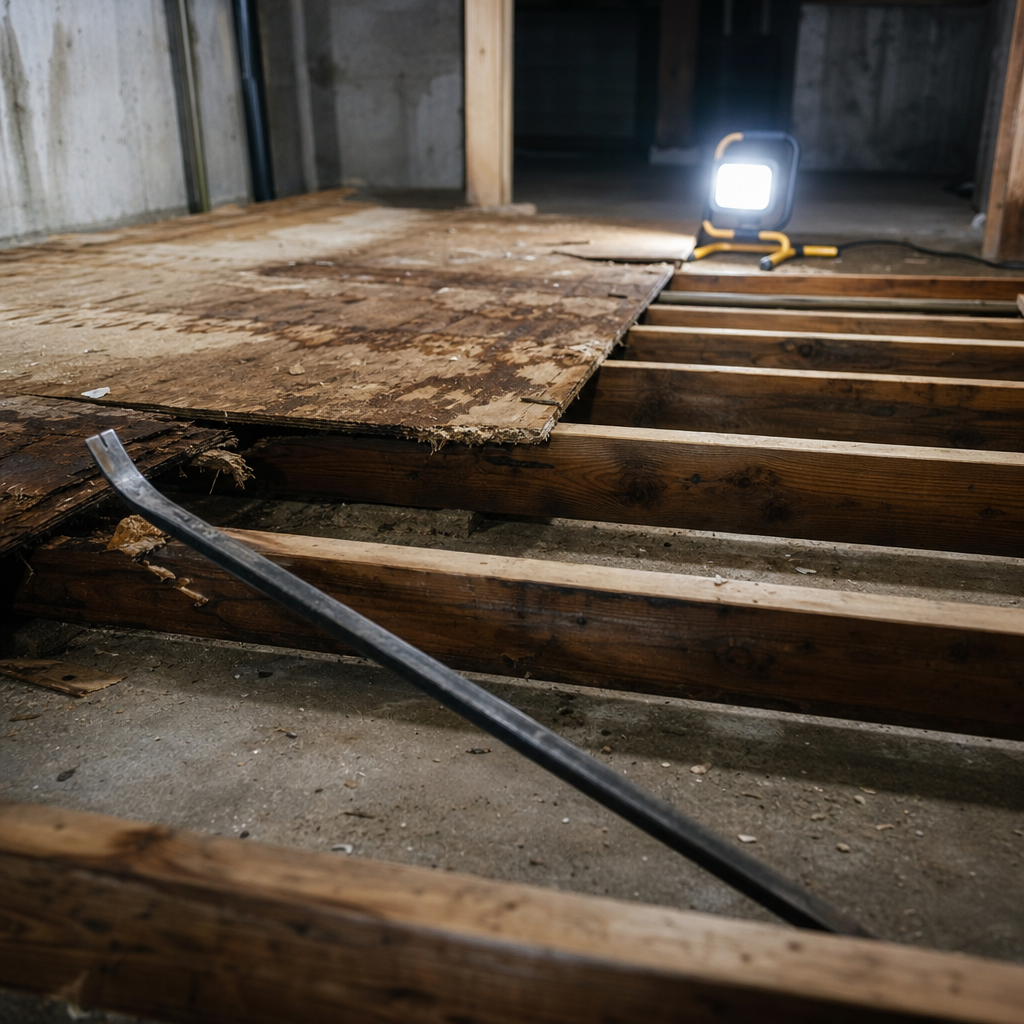
Following a sewage backup, deciding what to save and what to throw away comes down to material porosity. Industry standards under IICRC S500 specify that porous materials soaked in Category 3 black water cannot be completely sanitized and must be removed.
Evaluating Below-Grade Concrete and Joist Saturation
Under general restoration guidance followed by Floodline Restoration Co., poured concrete floors and solid dimensional lumber can often be saved if treated promptly. Technicians evaluate moisture levels to map how far contamination traveled beneath the surface. Once bulk waste is removed, concrete is scrubbed with disinfectants and dried using commercial dehumidifiers.
When to Sanitize vs. Tear Out Building Materials
Understanding which building elements are salvageable helps property owners verify contractor scopes and avoid unnecessary replacement charges:
| Material | Protocol | Action Required |
|---|---|---|
| Carpet & Padding | Non-salvageable | Cut, bag, and discard immediately. Trapped contaminants cannot be fully rinsed out. |
| Laminate & Engineered Wood | Non-salvageable | Porous composite layers swell and trap moisture in the underlayment. Remove completely. |
| Poured Concrete Slabs | Salvageable | Wash with EPA-registered disinfectants; run industrial drying systems. |
| Solid Dimensional Wood Joists | Salvageable | Scrape, clean, apply antimicrobials, and seal if necessary. |
Drywall, Cavity Insulation, and HVAC: Preventing Secondary Hazards
As general restoration guidance, contaminated moisture moves upward through wall assemblies through capillary action. When raw sewage touches the base of a wall, it can wick up drywall and saturate interior cavity insulation.
General Restoration Guidance: Flood Cut and Containment Protocol
In general restoration guidance, specialists at Floodline Restoration Co. perform “flood cuts” to dry wall cavities. This process typically involves cutting drywall horizontally above the highest water mark to expose wet wall studs, remove contaminated insulation, and open the cavity to airflow.
- Isolate the work zone: Seal doorways with plastic sheeting and run negative air machines.
- Execute flood cuts: Remove drywall above the saturation line to inspect interior framing.
- Extract saturated insulation: Bag wet insulation directly at the wall cavity to prevent cross-contaminating clean areas.
- Apply antimicrobial washes: Treat studs and sole plates directly with disinfectants.
General Restoration Guidance: HVAC Duct Sanitization
Under general restoration guidance, if a heating or cooling system ran while raw sewage was present, contaminants and odors may enter return vents. Technicians inspect ductwork, replace air filters, and clean the system to prevent contaminated air from circulating through the building.
Does Insurance Cover Sewage Cleanup Costs?
Standard homeowners insurance policies rarely cover drain or sewer backups automatically. In most cases, standard policies explicitly exclude water that enters the home through sewers, drains, or sump pump failures.
Coverage typically requires specific optional endorsements or riders. Having clear documentation from professionals like Floodline Restoration Co. (including moisture logs, room-by-room photos, and itemized scopes of work) is vital for claims processing.
Frequently Asked Questions About Sewage Cleanup and Costs
How much does sewage extraction and sanitization cost per square foot?
According to independent pricing guides, sewage extraction and biohazard remediation generally fall in the approximate range of $7 to $15 per square foot. This rate typically covers emergency extraction, disposal of porous materials, application of EPA-registered antimicrobials, and structural drying equipment.
What is the cost difference between clean water and black water cleanup?
Clean water cleanup generally costs significantly less per square foot because materials can often be dried in place without biohazard protocols. Black water cleanup falls into an approximate range of $7 to $15+ per square foot due to material removal requirements, protective gear, containment, and specialized disinfection.[3]
Does homeowners insurance cover sewage backup cleanup?
Standard homeowners insurance policies usually exclude sewage backups unless you have added specific sewer backup coverage or endorsements to your policy. Coverage details and deductibles vary by policy.
Can I clean up a sewage backup myself to save money?
According to general restoration guidance and Floodline Restoration Co., DIY cleanup is not recommended for Category 3 sewage backups due to biological contaminants. Standard household tools cannot properly extract moisture from subfloors or behind walls, and improper airflow can spread contamination throughout the property.
How long does the sewage cleanup and decontamination process take?
Under general restoration guidance, timelines vary depending on the severity of the damage. Initial extraction, material removal, and sanitization typically take several days, followed by structural drying and dehumidification before the space is ready for rebuilding.
Sources
- GAO-20-195G, Cost Estimating and Assessment Guide: Best Practice by Developing and Managing Program Cost – gao.gov
- Sewage Clean Up Cost: Typical Price Ranges and What Drives It 2026 – currentcost.org (2026)
- Sewage Cleanup Cost Calculator - 2026 Remediation Estimator – usecalcpro.com (2026)
Related reading: Ceiling Water Damage Repair Cost | Call Now-10% Off | On-Site in 60 Minutes | Free Estimate
Frequently Asked Questions
What specific insurance rider is required to cover sewage cleanup costs?
Homeowners must typically purchase an optional Water Backup and Sump Overflow endorsement, as standard policies exclude drain and sewer backups. Floodline Restoration Co. works directly with insurance adjusters, submitting detailed moisture mapping and itemized documentation to expedite claim approvals.
Is it safe to remain inside the home during Category 3 sewage remediation?
Occupants can sometimes stay if the backup is confined to a basement isolated with sealed containment barriers and negative air pressure. However, widespread Category 3 black water exposure poses respiratory biohazard risks, leading Floodline Restoration Co. to recommend temporary relocation until industrial HEPA scrubbing and antimicrobial treatments are complete.
How do restoration specialists detect hidden sewage wicking before issuing a fixed-price quote?
Technicians use thermal imaging cameras and non-invasive moisture meters to trace wastewater migration inside structural framing, party walls, and porous masonry. Floodline Restoration Co. performs this visual and structural assessment upfront to deliver an accurate, fixed-price estimate without hidden demolition surprises.
About the author
 |
Christopher Vance Christopher Vance brings over 12 years of hands-on experience in water mitigation and structural drying, holding multiple certifications from the Institute of Inspection, Cleaning and Restoration Certification (IICRC). Before shifting his focus to consumer education, he managed large-loss commercial and residential recovery operations throughout the New York metropolitan area. He specializes in breaking down complex restoration processes and pricing models to help property owners make informed decisions during high-stress situations. |
Water damage, flood, or mold emergency?
We’re available now - call for a fast, free estimate.
Call Now - Free Estimate