
Quick Summary
Effective water damage drying is critical for halting deep moisture migration across drywall, subfloors, and framing assemblies before secondary mold growth and structural decay occur. Floodline Restoration Co. delivers advanced psychrometric drying, rapid liquid extraction, and calibrated moisture tracking to safely stabilize building substrates beyond basic surface evaporation. Readers will understand the technical stages of structural moisture remediation and how to secure 24/7 emergency water damage drying services across Elmhurst, NY.
Water Damage Drying: Structural Cleanup and Moisture Monitoring
When clean or contaminated water enters a property, structural drying helps prevent material damage and fungal growth. Building moisture issues stem from many sources, including sewer backups, burst plumbing, roof leaks, and condensation. The National Academies of Sciences, Engineering, and Medicine found that at least 20% of buildings in reviewed datasets show visible dampness. Ongoing moisture is associated with higher concentrations of culturable fungi compared to materials dried quickly.[1]
Structural Water Damage Drying Timelines
Drying timelines in brief: Drying time varies with water volume, materials, environmental conditions, and building assemblies. Drying should continue until moisture measurements reach applicable targets. As practiced by specialists at Floodline Restoration Co., proper drying must always be confirmed with calibrated moisture meters rather than visual checks alone.[3] See also Commercial Water Damage Restoration – 10% Off & Free Estimate – Same-Day Service.
The speed of structural drying depends on how quickly liquid extraction begins, the volume of water involved, and the specific materials affected. Denser materials release bound water more slowly than porous materials.
Key Factors That Dictate Drying Timelines
Several environmental and structural variables determine how long a building takes to reach its dry target:
- Material Porosity: Gypsum board and denser structural materials absorb and release moisture at different rates.
- Rate of Wetting vs. Rate of Drying: The longer water sits before extraction, the deeper it migrates into framing and structural assemblies.
- Psychrometric Conditions: Ambient temperature, relative humidity, and vapor pressure must be balanced to draw water vapor out of wet assemblies.
Moisture and Microbial Growth Considerations
Ongoing moisture is associated with higher concentrations of culturable fungi. The CDC recommends ventilation, fans, or dehumidifiers and removal of porous materials that remain wet for more than 48 hours when they cannot be thoroughly cleaned and dried.[2]
Drying Structural Materials: Drywall, Hardwood, and Masonry
Every building material interacts with moisture differently. Effective mitigation requires matching air movement and dehumidification to the density and permeability of each specific substrate.
Drywall, Plaster, and Cavity Insulation
Drywall may be dried in place when it has no obvious swelling and seams remain intact; swollen or compromised drywall should be removed. Cavity-drying systems may be used to deliver airflow into wall cavities. Fibrous insulation saturated by contaminated floodwater should be removed, while some foam-plastic insulation may be dried in place depending on condition and contamination.
Masonry and Dense Substrates
Dense structural assemblies such as brick and concrete subfloors require controlled drying environments. According to protocols from Floodline Restoration Co., proper drying utilizes dehumidifiers paired with air movers to manage moisture removal across assemblies.[4]
| Material Type | Monitoring Method | Restoration Approach |
|---|---|---|
| Standard Drywall and Gypsum | Moisture meters | Dehumidification, air movers, or cavity-drying systems; removal if swollen or compromised |
| Hardwood and Wood Subflooring | Moisture meters | Dehumidification and controlled airflow to extract moisture from assemblies |
| Brick, Plaster, and Concrete | Moisture meters and psychrometric instruments | Dehumidification and air movers to support steady moisture reduction |
Hardwood Flooring and Subfloor Systems
A study by researchers at Purdue University used moisture-content readings as the primary gauge for evaluating successful drying in wood assemblies. Visual flatness alone does not confirm that subflooring materials have reached target moisture levels.[5]
Professional Structural Drying Process
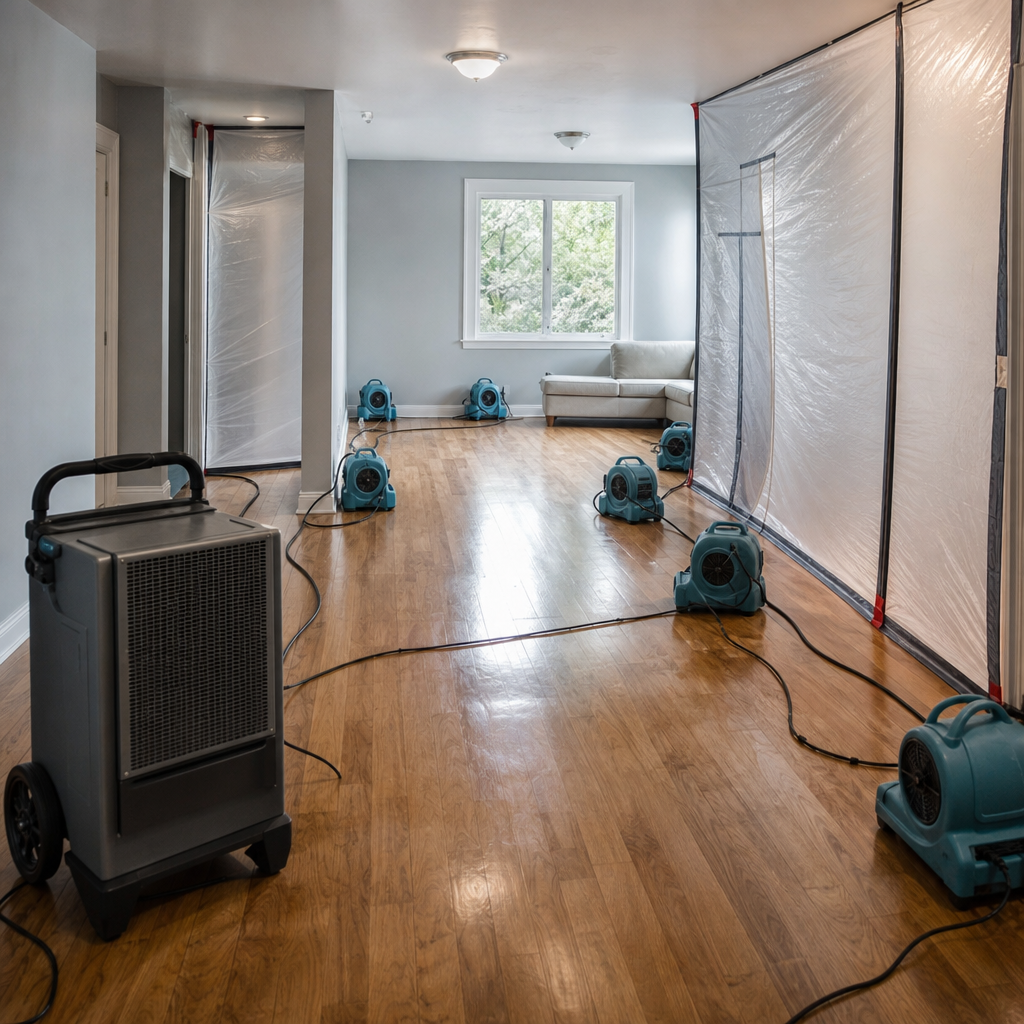
Restoration teams follow an established sequence to stabilize wet buildings, protect structural components, and address moisture.
-
Step 1: Moisture Mapping and Water Extraction
Technicians at Floodline Restoration Co. use moisture meters to assess the migration of moisture. Extraction tools then remove standing liquid, which aids the subsequent evaporation phase.
-
Step 2: Controlled Airflow and Dehumidification
Air movers provide continuous airflow across wet surfaces. Dehumidifiers remove evaporated moisture vapor from the air to keep relative humidity within target ranges.
-
Step 3: Material Assessment and Selective Removal
Technicians inspect porous assemblies. Compromised drywall, saturated fibrous insulation, and materials affected by contaminated water are removed as appropriate.
-
Step 4: Moisture Monitoring and Documentation
Technicians monitor moisture levels using moisture meters and psychrometric instruments. Drying equipment remains operational until structural materials reach established moisture targets.
Structural Drying Considerations
A study from University of New Orleans researchers found that natural ventilation did not effectively reduce gypsum-board moisture after prolonged flooding. Professional structural drying by teams like Floodline Restoration Co. utilizes extraction tools, air movers, dehumidifiers, and psychrometric instruments to extract water and monitor moisture levels effectively.
Frequently Asked Questions About Water Damage Drying
Quick Summary: Professional drying has no universal duration and requires documented moisture monitoring. Drywall may be dried in place when it has no obvious swelling and seams remain intact; swollen drywall and contaminated fibrous insulation should be removed.
How long does it take to completely dry out water damage?
Professional drying has no universal duration and requires documented moisture monitoring. Drying time varies with water volume, materials, environmental conditions, and building assemblies. Drying should continue until moisture measurements reach applicable targets.
What equipment is used in professional structural drying?
Equipment supported for structural drying includes extraction tools, air movers, dehumidifiers, moisture meters, psychrometric instruments, and cavity-drying systems.
Can water-damaged drywall and insulation be dried and saved?
Drywall may be dried in place when it has no obvious swelling and seams remain intact; swollen or compromised drywall should be removed. Fibrous insulation saturated by contaminated floodwater should be removed, while some foam-plastic insulation may be dried in place depending on condition and contamination.
How do contractors test if walls and subfloors are fully dry?
Technicians at Floodline Restoration Co. take moisture readings using calibrated moisture meters and psychrometric instruments, comparing readings against predetermined targets or unaffected reference materials.
Can I dry out water damage myself or should I hire a contractor?
Small surface spills may be resolved with basic drying equipment if addressed promptly. When water penetrates wall cavities, subflooring, or dense structural assemblies, extraction tools, dehumidifiers, air movers, and documented moisture monitoring are necessary to achieve target moisture levels.
Sources
- Building Moisture and Durability -PAST, PRESENT AND FUTURE WORK – huduser.gov (2001)
- Homeowner’s and renter’s guide to mold cleanup after disasters – stacks.cdc.gov (2015)
- Moisture control and ventilation – NCBI – NIH – ncbi.nlm.nih.gov (2004)
- Damp Buildings – Damp Indoor Spaces and Health – ncbi.nlm.nih.gov
- [PDF] Use of Moisture Measuring Devices for Evaluating Water Damage in … – mass.gov
Related reading: Mold Remediation Cost – Call Now-10% Off – Same-Day Service – Free Estimate
Related reading: Does Insurance Cover Water Damage | Call Now-10% Off | Same-Day Service | Free Estimate
Related reading: New York State Mold Laws – Call Now-10% Off – Same-Day Service – Free Estimate
Frequently Asked Questions
Why is psychrometric drying more effective than standard fans for structural water damage?
Standard fans only accelerate surface evaporation, which can push moisture deeper into wall cavities and structural framing. Floodline Restoration Co. utilizes psychrometric drying principles to balance temperature, relative humidity, and vapor pressure, actively extracting trapped moisture out of dense building assemblies before mold colonies develop.
Why are daily moisture logs and calibrated meter readings necessary during water damage drying?
Visual checks fail to detect trapped moisture inside subfloors and framing, which can cause gradual rot and secondary fungal growth. Floodline Restoration Co. maintains detailed daily moisture logs using calibrated psychrometric instruments to verify assemblies have reached target dry standards and to provide required documentation for insurance claims.
How quickly does structural water damage drying need to begin to prevent permanent framing decay?
Professional water extraction and structural drying should begin within 24 to 48 hours to halt rapid microbial proliferation and framing degradation. Property owners in Elmhurst, NY can rely on Floodline Restoration Co. for 24/7 rapid response, deploying specialized cavity-drying systems that salvage restorable drywall and protect internal structural framing.
About the author
 |
Christopher Vance Christopher Vance brings over 12 years of hands-on experience in water mitigation and structural drying, holding multiple certifications from the Institute of Inspection, Cleaning and Restoration Certification (IICRC). Before shifting his focus to consumer education, he managed large-loss commercial and residential recovery operations throughout the New York metropolitan area. He specializes in breaking down complex restoration processes and pricing models to help property owners make informed decisions during high-stress situations. |
Water damage, flood, or mold emergency?
We’re available now - call for a fast, free estimate.
Call Now - Free Estimate