
Quick Summary
Water mitigation costs typically range from $1,200 for minor clean water leaks to over $12,000 for severe sewage backups, with total expenses driven by water contamination categories and structural drying times. Floodline Restoration Co. delivers rapid emergency extraction and upfront, itemized scopes to stop moisture migration within 24 to 48 hours and eliminate friction during insurance claim processing. Property owners will understand how structural drying pricing works across various building materials and can promptly request an on-site visual inspection or 24/7 emergency dispatch to prevent costly secondary damage.
Water Mitigation Cost – Upfront Pricing & Fast Drying
When clean water or raw sewage floods your property, fast action makes the difference between a simple drying job and a multi-week structural rebuild. Unverified industry pricing estimates place baseline water mitigation costs between $3.00 and $7.50 per square foot for basic drying. However, real-world expenses vary significantly based on water contamination levels, building materials, and structural access. FEMA describes flooding as the most common and most expensive disaster type in the United States, meaning delayed extraction quickly compounds total losses.[1]
Stopping moisture within the first 24 to 48 hours protects subflooring, drywall, and shared building envelopes from secondary mold damage. This guide, with insights from Floodline Restoration Co., outlines how emergency mitigation pricing works, how structural drying differs from full reconstruction, and how insurance adjusters calculate claim payouts. See also Water Damage Repair Pricing | Call Now-10% Off | On-Site in 60 Minutes | Free Estimate.
How Much Does Water Mitigation Cost? (Average Rates and Summary)
Quick Summary: Most standard water extraction and structural drying projects range from $1,200 to $5,000 for clean water incidents in isolated rooms, while whole-floor flooding or contaminated sewage backups typically cost between $4,500 and $12,000+. Total pricing depends on contamination levels, drying equipment runtime, and how deep water has penetrated structural materials.[4]
A typical water mitigation invoice covers emergency extraction, controlled demolition of unsalvageable porous materials, antimicrobial treatments, and several days of commercial dehumidification. According to data tracked by the Insurance Information Institute, water damage and freezing issues rank among the largest and most frequent property loss categories filed by property owners each year.
Price Breakdown by Water Cleanliness Category
The Institute of Inspection, Cleaning and Restoration Certification (IICRC) establishes three distinct categories of water damage. Each category requires different safety gear, extraction methods, and disposal protocols, directly shaping your overall project estimate (the following cost ranges are non-authoritative estimates):
- Category 1 (Clean Water – Non-Authoritative Estimate: $3.00 to $4.50 per sq. ft.): Originates from sanitary sources such as broken supply pipes, overflowing sinks, or rainwater entering through an open window. If treated within 24 to 48 hours, materials like framing and some subfloors can be dried in place with minimal tear-out.
- Category 2 (Gray Water – Non-Authoritative Estimate: $4.50 to $6.50 per sq. ft.): Contains chemical or biological contaminants that cause illness if handled incorrectly. Typical sources include washing machine overflows, dishwasher discharge, and sump pump failures. Saturated carpet padding and insulation must be removed and safely discarded.
- Category 3 (Black Water – Non-Authoritative Estimate: $7.00 to $12.00+ per sq. ft.): Grossly unsanitary water carrying pathogens, bacteria, and toxins. Sources include municipal sewer line backups, toilet backflows containing feces, and rising ground floodwaters. All porous materials touching black water must be stripped down to the structural studs and masonry, followed by extensive biocide disinfection.
Water Mitigation Cost Breakdown by Service Type
Need water mitigation cost?
We’re available now - call for a fast, free estimate.
Emergency mitigation focuses strictly on stopping active moisture spread, stabilizing the structure, and returning materials to their standard dry baseline. This step is distinct from reconstruction, which covers the physical rebuilding of finishes after the structure is completely dry.
| Loss Scenario | Primary Mitigation Procedures | Average Cost Range |
|---|---|---|
| Clean Water Pipe Burst | Standing water extraction, baseboard removal, air mover and LGR dehumidifier placement for 3-4 days. | $1,500 – $3,800 |
| Multi-Room Structural Saturation | High-volume extraction, targeted wall cavity drying, flood cuts to saturated drywall, subfloor mat drying. | $3,500 – $8,200 |
| Basement Sewage Backup | Biohazard pumping, contaminated material disposal, pressure washing, hospital-grade biocide application, containment. | $4,800 – $12,500+ |
Mitigation vs. Full Water Damage Restoration
Property owners often mix up water mitigation and water restoration:
- Water Mitigation: Emergency extraction, controlled demolition of ruined drywall, sanitizing, and mechanical drying using commercial dehumidifiers and air movers. Mitigation stops ongoing decay.
- Water Restoration (Reconstruction): Reinstalling subflooring, hanging new drywall, taping, priming, painting, and setting new trim once moisture levels normalize. Restoration rebuilds the property.
Drywall, Ceilings, and Shared Masonry: Urban Water Migration Factors
Standard online square-footage calculators frequently fail for urban properties, attached row houses, and pre-war brick buildings. Generic estimates assume detached wood framing on concrete slabs, completely ignoring how water moves through dense masonry.
In attached brick homes, porous masonry party walls pull water horizontally through capillary action (wicking). When a second-floor pipe bursts or a basement floods, moisture migrates deep into shared brick boundaries between adjoining properties. If left unchecked, this trapped moisture leads to hidden structural rot and mold colonization within common wall cavities.[2]
Warning Signs of Saturated Wall Cavities
Moisture trapped behind plaster or drywall requires targeted cavity drying or selective removal. Common warning signs include:
- Bowing, soft, or sponge-like drywall panels along baseboards.
- Blistering, peeling paint or chalky efflorescence on interior brickwork.
- Sagging, heavy plaster ceilings beneath bathroom and kitchen plumbing runs.
- Musty, earthy odors that worsen when heating or air conditioning runs.
The 24-Hour Drywall Decision Rule
Technicians at Floodline Restoration Co. evaluate wall assemblies using a practical timeline:
- Under 24 Hours (Category 1): If dry gypsum drywall has not lost structural rigidity, it can often be dried without demolition by running wall cavity injection systems through small holes drilled behind removed baseboards.
- Over 24 to 48 Hours, or Any Category 2/3 Water: Gypsum binders break down quickly once soaked, and paper backings create ideal environments for microbial growth. Technicians perform precision flood cuts 12 to 24 inches above the highest moisture boundary to remove wet insulation and expose wall cavities for direct airflow.
Historical disaster records compiled by the NOAA National Centers for Environmental Information illustrate how rapidly unaddressed water losses turn into massive financial burdens. Furthermore, a report from the Congressional Research Service noted that flood-related losses across the nation averaged roughly $46 billion per year over the past decade (in 2023 dollars), highlighting the compounding costs of delayed structural dry-out.[3]
Hardwood Floors, Subfloors, and Joists: Structural Extraction Costs
Need water mitigation cost?
We’re available now - call for a fast, free estimate.
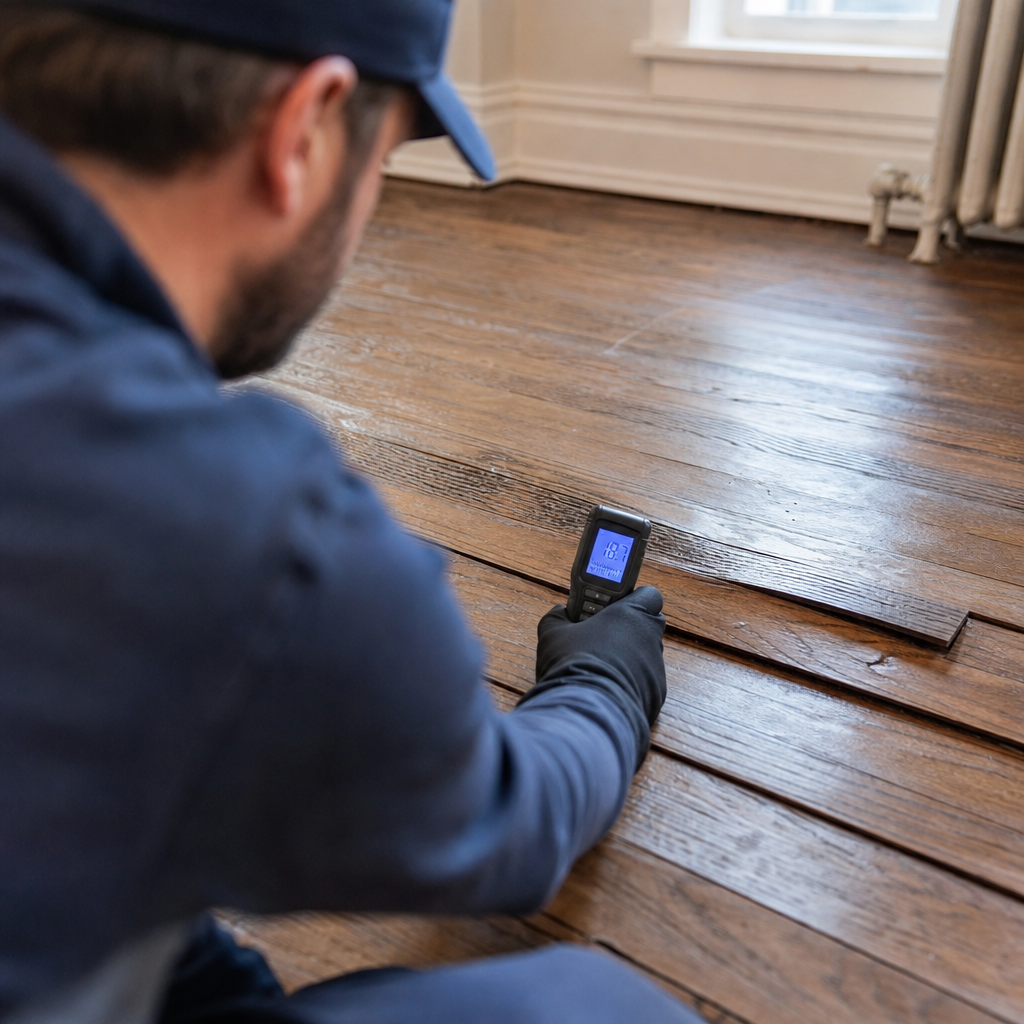
Standing water on hardwood flooring requires rapid intervention before planks warp, cup, or buckle beyond repair. Salvaging hardwood floors generally costs less than tearing out tongue-and-groove boards and installing new subfloors.
Cupping vs. Crowning
When water sits on hardwood, the bottom of each plank absorbs moisture faster than the finished top surface, causing the edges to rise higher than the center (cupping). If cupped flooring is sanded down before the subfloor dries, the edges will sink once normalized, creating a permanently rounded board (crowning).
Restoration specialists at Floodline Restoration Co. monitor Wood Moisture Equivalent (WME) percentages. Normal indoor wood readings typically sit between 7% and 11%. When readings exceed 16%, structural decay and subfloor delamination become active risks. In older attached structures, wooden floor joists pocketed directly into brick party walls absorb moisture from damp masonry, making thorough moisture mapping essential.
Floor Mat Vacuum Extraction vs. Subfloor Rebuilding
| Method | Application | Cost & Impact |
|---|---|---|
| Negative Pressure Vacuum Mats | Placed directly over cupping hardwood to draw water out of deep subfloors without tearing up original planks. | Lower overall cost; saves historical flooring and cuts reconstruction time. |
| Subfloor Demolition & Replacement | Required when saturated underlayment delaminates, joists warp, or black water contaminates floor cavities. | Higher cost; requires full demo, framing repairs, new plywood, and brand new floor installation. |
Basement Floods and Sewage Cleanups: Category 3 Protocol
Basement floods caused by municipal drain backups require immediate professional biohazard mitigation. In neighborhoods with aging combined sewer systems, intense rainfall can overwhelm underground storm and sanitary lines, forcing black water backward into below-grade basements and garden apartments.
Category 3 Biohazard Safety Protocols
According to Floodline Restoration Co., sewage cleanup requires strict containment procedures to protect living areas from airborne pathogens and contaminated particulate matter:
- Containment and Air Scrubbing: Setting up physical plastic barriers and HEPA air filtration units under negative pressure to keep airborne contaminants from migrating into upper living floors.
- Bulk Extraction and Debris Removal: Extracting raw sewage using specialized commercial vacuums, followed by bagging and hauling ruined carpet, baseboards, and drywall in accordance with local sanitation guidelines.
- Structural Decontamination: Washing down exposed concrete slabs, foundation blocks, and framing with EPA-registered hospital-grade biocides to eliminate bacteria, viruses, and mold spores.
- Controlled Mechanical Drying: Running commercial low-grain refrigerant (LGR) or desiccant dehumidifiers to drop relative humidity below 40%, drawing residual moisture out of concrete foundations and brick footings.
Does Insurance Cover Water Mitigation, and How Are Claims Calculated?
Most standard homeowners policies cover water mitigation expenses when the source of damage is sudden and accidental (such as an unexpected pipe burst, water heater failure, or ruptured appliance hose). Standard policies typically exclude gradual leaks that went unaddressed for months, along with surface ground flooding, which requires a separate National Flood Insurance Program (NFIP) or private flood policy.
Standard Insurance Claim Documentation
Insurance adjusters approve mitigation payouts based on verifiable, line-item data rather than lump-sum estimates.
To ensure smooth claim processing without out-of-pocket disputes, mitigation records must include:
- Infrared Thermal Images & Moisture Maps: Visual proof documenting exact moisture boundaries across floors, walls, and structural studs on day one.
- Daily Psychrometric Moisture Logs: Recorded readings of ambient temperature, relative humidity, and grains per pound (GPP) showing steady moisture reduction as equipment operates.
- Itemized Equipment Logs: Specific runtime records for every air mover, HEPA air scrubber, and dehumidifier placed on site.
Working with an emergency restoration contractor like Floodline Restoration Co. who directly coordinates with your insurance adjuster and provides clear, upfront pricing helps you restore your property quickly and avoid unexpected billing surprises.
Need water mitigation cost?
We’re available now - call for a fast, free estimate.
Sources
- Understanding NOAA's “Billion-Dollar Disasters” – congress.gov (2025)
- The Cost of Flooding – floodsmart.gov (2024)
- Billion-Dollar Weather and Climate Disasters – ncei.noaa.gov
- The Rising Cost of Water Damage in American Homes … – thesource.com (2026)
Related reading: Ceiling Water Damage Repair Cost | Call Now-10% Off | On-Site in 60 Minutes | Free Estimate
Related reading: Sewage Cleanup Cost – 10% Off & Free Estimate – Same-Day Service
Frequently Asked Questions
How long does structural water mitigation take, and how does drying time impact total cost?
Standard structural drying typically takes 3 to 5 days depending on the water category and material saturation. Floodline Restoration Co. tracks daily psychrometric readings to optimize commercial dehumidifier runtime, ensuring equipment is removed as soon as dry baselines are met to control overall expenses.
Will homeowners insurance pay the water mitigation contractor directly?
Yes, for covered sudden water losses, most insurers accept direct billing from certified contractors once you pay your policy deductible. Floodline Restoration Co. coordinates directly with insurance adjusters, submitting itemized moisture logs and thermal imaging data to ensure swift claim approval without unexpected out-of-pocket fees.
How can I get an accurate water mitigation cost estimate before emergency work begins?
Accurate pricing requires an on-site inspection using moisture meters and thermal imaging to map hidden water migration in walls, floors, and subfloors. Floodline Restoration Co. provides free visual inspections with upfront, transparent pricing scopes and offers 24/7 local dispatch to begin critical extraction immediately.
About the author
 |
Christopher Vance Christopher Vance brings over 12 years of hands-on experience in water mitigation and structural drying, holding multiple certifications from the Institute of Inspection, Cleaning and Restoration Certification (IICRC). Before shifting his focus to consumer education, he managed large-loss commercial and residential recovery operations throughout the New York metropolitan area. He specializes in breaking down complex restoration processes and pricing models to help property owners make informed decisions during high-stress situations. |
Water damage, flood, or mold emergency?
We’re available now - call for a fast, free estimate.
Call Now - Free Estimate