
Quick Summary
Understanding whether homeowners insurance covers water damage is essential for property owners facing unexpected plumbing failures, appliance leaks, or storm intrusion. While standard policies typically pay for sudden and accidental discharges but exclude overland flooding and gradual maintenance issues, Floodline Restoration Co. emphasizes that thorough professional documentation is key to claim approval. After reading this guide, homeowners will understand critical coverage distinctions, policy exclusions, and how to schedule a visual inspection and claim assessment with certified specialists.
“`html
Does Homeowners Insurance Cover Water Damage? Claim Guide
Homeowners policies typically cover water damage from plumbing or roof leaks, depending on the policy and circumstances, while flood damage is generally excluded from standard homeowners insurance and usually requires separate flood insurance. Standard homeowners insurance also generally does not cover groundwater or damage caused by gradual leaks and deferred maintenance.[2]
Whether a claim is approved often depends on the cause of the damage and the terms of your policy. Documenting the damage, understanding policy provisions, and taking appropriate steps to protect your property can help prevent claim issues. See also Water Damage Repair Pricing | Call Now-10% Off | On-Site in 60 Minutes | Free Estimate.
Does Homeowners Insurance Cover Water Damage? Policy Overview
Property policies generally cover certain sudden and accidental losses. When water unexpectedly escapes from a plumbing line or household appliance, the policy may cover related structural repairs and cleanup, depending on the policy and circumstances, subject to your deductible.
Coverage depends on the origin of the water and the specific peril involved. Damage resulting from external flooding, groundwater, or ongoing maintenance issues typically falls outside standard policy protections.[4]
Sudden and Accidental vs. Gradual Damage
A key factor in coverage determinations is whether the damage occurred suddenly or developed gradually over time. A pipe that bursts unexpectedly is generally treated differently from a slow, chronic leak that causes rot or deterioration over an extended period. As specialists at Floodline Restoration Co. note, because coverage depends on the policy and circumstances, providing clear documentation of the loss can help establish how and when the damage occurred.[3]
Documenting Damage and Protecting Your Property
Policies generally require homeowners to take reasonable steps after a loss to protect the property from further damage. This typically includes stopping the water source, documenting the damage before cleanup begins, and retaining damaged parts or items for inspection when feasible.
Covered vs. Excluded Water Damage: What Policies Pay For
Coverage depends on the specific policy language, endorsements, and the circumstances surrounding the loss.
| Loss Event | Standard Homeowners Policy | Water Backup Coverage / Endorsement | Flood Insurance Policy |
|---|---|---|---|
| Burst Plumbing Supply Line or Frozen Pipe | May be covered (depending on policy and circumstances) | May not apply | Generally excluded |
| Municipal Sewer or Drain Backup | Generally excluded (may require separate or added coverage) | May be covered (depending on policy and circumstances) | Generally excluded |
| Overland Flooding or Surface Runoff | Generally excluded | Generally excluded | Typically covered (depending on policy and circumstances) |
| Slow, Gradual Leak or Ongoing Seepage | Generally excluded | Generally excluded | Generally excluded |
Water Damage Events Often Covered by Standard Policies
Depending on policy terms and circumstances, standard policies may cover sudden and accidental water discharges, such as:
- Burst or frozen pipes (where heat was properly maintained).
- Sudden appliance failures or ruptured supply lines.
- Accidental overflow from plumbing fixtures.
- Water entering through sudden, storm-created openings in roofs or windows.
Common Exclusions That Require Additional Coverage
Standard homeowners policies generally exclude certain types of water events:
- Overland Flooding: Damage from rising bodies of water, surface runoff, or storm surges is generally excluded from standard homeowners policies and usually requires separate flood insurance. According to National Flood Insurance Program (NFIP) data, almost one-third of its claims from 2014 to 2024 came from outside mapped high-risk areas; however, this statistic does not measure standard homeowners-policy coverage.
- Groundwater: Standard homeowners insurance generally does not cover groundwater, such as moisture or water entering through foundations, basement floors, or below-grade walls.
- Gradual Deterioration: Damage resulting from slow leaks, rot, or deferred maintenance is generally excluded.
Sewage and Drain Backups
Standard homeowners policies generally do not cover damage caused by sewer or drain backups. Coverage for these incidents may require separate or added coverage, such as a water backup endorsement, with limits and terms specified in the policy.[5]
Vulnerable Structural Components: Drywall, Flooring, and Basements
Need does homeowners insurance cover water damage?
We’re available now - call for a fast, free estimate.
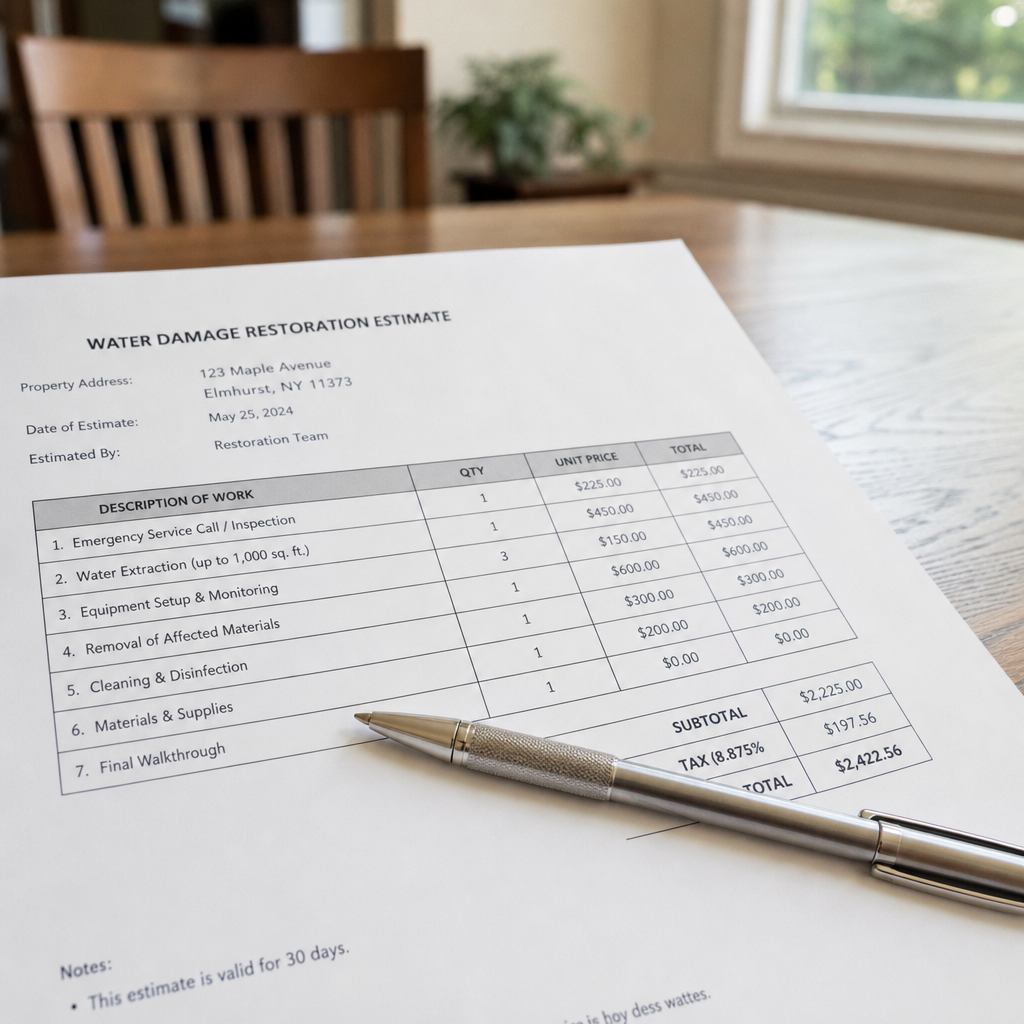
Water can spread through building materials, affecting multiple structural assemblies:
Drywall and Ceilings
Drywall and insulation can absorb water quickly when leaks occur from upper floors or roofs. Depending on the policy and circumstances, repairs to damaged ceilings and walls may be covered if the underlying cause is a covered peril.
Flooring and Subflooring
As noted by Floodline Restoration Co., hardwood, laminate, and subflooring can swell, warp, or deteriorate when exposed to standing water. Coverage for flooring repairs or replacement depends on the policy provisions and whether the water discharge was sudden and accidental.
Basements and Crawl Spaces
Below-grade areas are particularly susceptible to water intrusion. Determining whether the source was an internal plumbing failure, sewer backup, or groundwater dictates whether the loss is covered by standard insurance, an endorsement, or excluded entirely.
What to Know About Water Damage Restoration and Insurance Claims
Understanding policy terms and claims handling helps property owners navigate the restoration process effectively.
Deductibles and Policy Limits
Your deductible is the amount you are responsible for paying before insurance benefits apply. Any claim settlement will reflect the policy’s coverage limits, deductibles, and applicable exclusions. Working closely with your insurer regarding documentation and estimates helps keep the process transparent.
How to File a Water Damage Insurance Claim
To ensure a smooth claims process, follow these basic steps:
-
Step 1: Follow Policy Instructions and Notify the Insurer Promptly
Contact your insurance company promptly to report the loss and obtain specific instructions for filing your claim.
-
Step 2: Document Damage and Losses Before Cleanup
Take thorough photographs and videos of all damaged structures and personal belongings before cleanup or disposal begins, and take reasonable steps to prevent further damage.
-
Step 3: Submit Requested Forms and Maintain Written Records
Submit all requested documentation, such as an itemized inventory of damaged property and proof of value, and keep clear written records of all communications with your insurer and contractors.
Frequently Asked Questions About Water Damage Insurance
Does insurance cover ceiling water damage?
Coverage depends on the policy and circumstances. Ceiling damage caused by a sudden, covered peril-such as an unexpected pipe burst or sudden storm damage-may be covered. However, damage caused by gradual deterioration, long-term leaks, or lack of maintenance is generally excluded.
Does homeowners insurance cover mold from a pipe burst?
Whether mold is covered depends on the specific policy and circumstances. Some policies may provide limited coverage for mold resulting directly from a covered water loss, while mold caused by high humidity, poor ventilation, or unaddressed leaks is generally excluded.[1]
Is water mitigation and drying covered by insurance?
According to the team at Floodline Restoration Co., whether mitigation and drying expenses are covered depends on your policy and the circumstances of the loss. When a water loss is covered, necessary mitigation measures to protect the property from further damage may be covered, subject to policy terms and deductibles.
“`
Need does homeowners insurance cover water damage?
We’re available now - call for a fast, free estimate.
Sources
- national flood insurance program – media toolkit – agents.floodsmart.gov (2025)
- What is My Flood Risk – floodsmart.gov (2024)
- Disaster Recovery Resources – dfs.ny.gov
- Flood, Water Damage, and the Homeowners' Insurance … – trerc.tamu.edu
- Many homeowners have a big insurance coverage gap – cnbc.com
Related reading: Ceiling Water Damage Repair Cost | Call Now-10% Off | On-Site in 60 Minutes | Free Estimate
Related reading: Water Mitigation Cost | Call Now-10% Off | Same-Day Service | Free Estimate
Related reading: Sewage Cleanup Cost – 10% Off & Free Estimate – Same-Day Service
Frequently Asked Questions
How can I prove my water damage was sudden and accidental rather than gradual?
Proving a sudden loss requires objective evidence such as moisture mapping, date-stamped photographs, and expert cause-of-loss reports. Floodline Restoration Co. uses their Straight Claim Program to provide precise technical documentation that establishes the timeline of the failure, helping prevent claim denials based on alleged deferred maintenance.
Does homeowners insurance pay to replace the broken pipe that caused water damage?
While homeowners insurance generally pays for the resulting structural damage to drywall, flooring, and ceilings, it typically excludes the cost of repairing or replacing the specific plumbing component that failed. Scheduling a free visual inspection and claim documentation assessment with an IICRC-certified specialist from Floodline Restoration Co. ensures all secondary and structural damage is properly identified for your adjuster.
How quickly must water mitigation begin to avoid an insurance claim denial?
Insurance policies contain a duty to mitigate clause requiring homeowners to take prompt, reasonable action immediately upon discovering water intrusion. Unnecessary delays can lead to denied coverage for secondary issues like mold growth or structural rot, making emergency water extraction and professional drying essential within the first 24 to 48 hours.
About the author
 |
Christopher Vance Christopher Vance brings over 12 years of hands-on experience in water mitigation and structural drying, holding multiple certifications from the Institute of Inspection, Cleaning and Restoration Certification (IICRC). Before shifting his focus to consumer education, he managed large-loss commercial and residential recovery operations throughout the New York metropolitan area. He specializes in breaking down complex restoration processes and pricing models to help property owners make informed decisions during high-stress situations. |
Water damage, flood, or mold emergency?
We’re available now - call for a fast, free estimate.
Call Now - Free Estimate